Crane Drinks From Empty Cup

It is definitely a season for seeing teachers and friends! Over the last few months I have been in Japan and Okinawa, had a good visit from Kimo sensei, and most recently have hosted Liu Chang’I sifu. It’s been busy, but great fun! Sifu came for a short visit this time, but it is always good to see him. When he comes he stays with me, we train and talk about his art, eat too much duck, and have a weekend seminar. I met him in 1996 when he was visiting the US for the first time with Kimo Wall sensei. It was a good meeting and he taught a few of us some of the basic power development exercises from the system. We practiced them but it was over 10 years before we saw him again. He asked about the “thunder power” and where we had gotten with the ji bei gong he had shown us and was surprised to hear we had not got much result from them. Then he took a closer look and said simply: “oh, yes. You are doing them wrong. You will never get thunder power that way.” That started was has become a more in-depth practice of the art in the years since. I have hosted him here every year and have visited him in Taiwan to train. His visits are always fun, and the seminar we do here in Boston is a great time- we have interested and dedicated practitioners from a variety of arts that come together to train and touch hands. Hard training and good spirit!

The seminars are great, and a good opportunity to get a “taste” of the system. But when we do have them it also makes me think about how hard it can be to learn much in a couple of days. We train hard, and sifu is very open with his instruction and advice. You can certainly come away with something to practice. But I can’t help but get reminded of 10 years spent sort of doing the exercises and getting little result. Things like the ji bei gong from the Feeding Crane can seem very simple. They are not very complex movements. Most are done in a standing position, in one of three stances, and some use a single turn or a simple triangle step. But do them improperly and you get little out of them. You can even hurt yourself doing them if you do them wrong. Most importantly, you must practice them using the framework they were developed in. One of the biggest mistakes I was making when I first did them was applying Goju “rules”. For example in a number of the Feeding Crane movements the elbow joint is fully extended, 100%. That allows the arm to transmit energy in a way that it cannot if even slightly bent. In Goju we rarely if ever lock out that joint- it is considered bad mechanics and bad tactics. Neither is correct, both are right in the appropriate context. But apply one rule to the other system and you get a poor result.
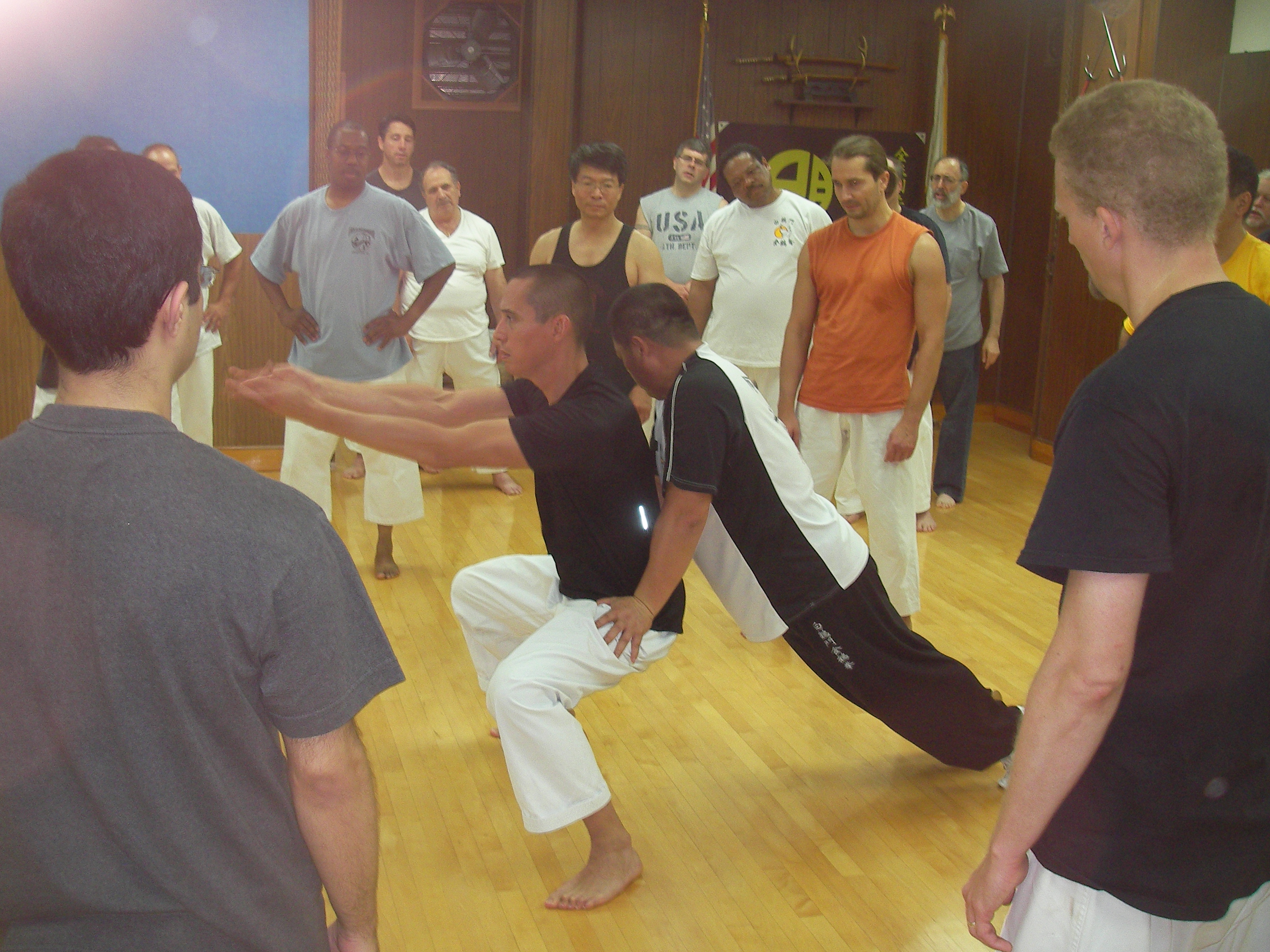
Sifu checking ma bu

Sifu checking ma bu

Much martial arts training is that way. It can seem simple, but proper instruction is required. Many of the important details are difficult or impossible to see if you are not told what to look for, and observation and correction from someone who understands both how to do and how to teach is essential. This is particularly true if you have experience in a different art- many of your “rules” will have become habit, and you may not even know you are following them. In my case, a few simple corrections and by his next visit some “thunder” was emerging. But to get there I needed both the corrections and the hard work that followed them. I needed to empty my cup and engage with a new system; if I had decided what I already knew was right and that I should not lock out the elbow, for example, I would still be getting poor results. So I had to admit that what I already knew may not have all the answers. In the process I’ve also learned a new appreciation for the “rules” of Goju, how they affect mechanical and tactical choices, and that I need to empty my cup there too. Win-win, really.

Seeing and training with sifu reminds me of that. It has also just been good to see one of my teachers again. Liu sifu is very personable, cares a great deal about both his system and his friends, and has a lovely family. I like spending time with him. That is important to me on a very fundamental level. His art is impressive. I have been around the martial arts a while now, and I have yet to see anyone else who is capable of delivering his power at such close range with such rapid succession. His methods work and I always learn something from him. But honestly if he was not a good person I would not be training with him. I have a full life, and no space in it for jerks. Unfortunately you see a fair number of those in the arts, but Liu sifu is not one of them. He is a great guy.

He is also very open with his knowledge, and wants to share it with anyone who is interested. That is something I have tried to keep part of our crane practice here. Members of our dojo and  Anthony Mirakian sensei’s Meibukan dojo get together every two weeks to train. Our versions of Goju are slightly different, but the spirit is the same. Mirakian sensei’s students have an excellent teacher, and it is great fun to train with them; they have a strong base, work hard, and have a really good attitude. Good people, and I am lucky to have been able to train with them the last few years. It is a rare opportunity to make some martial arts friends, and to touch hands with other people, and I look forward to it every time. In fact, over the years Mirakian sensei has been very generous to us. He has allowed me to teach his students in his dojo, which is very good of him. He has had us use his dojo both for our bi-monthly training sessions and for hosting the seminars and the closed training our two groups do when sifu is here. He has also hosted some very nice dinners for people participating in the annual seminars, and they have been great evenings. It is clear to me that he sees the value in sifu’s art, and in all of us coming together to practice it. I do too- it is such a good feeling to see people working together to share, sweat, and train!
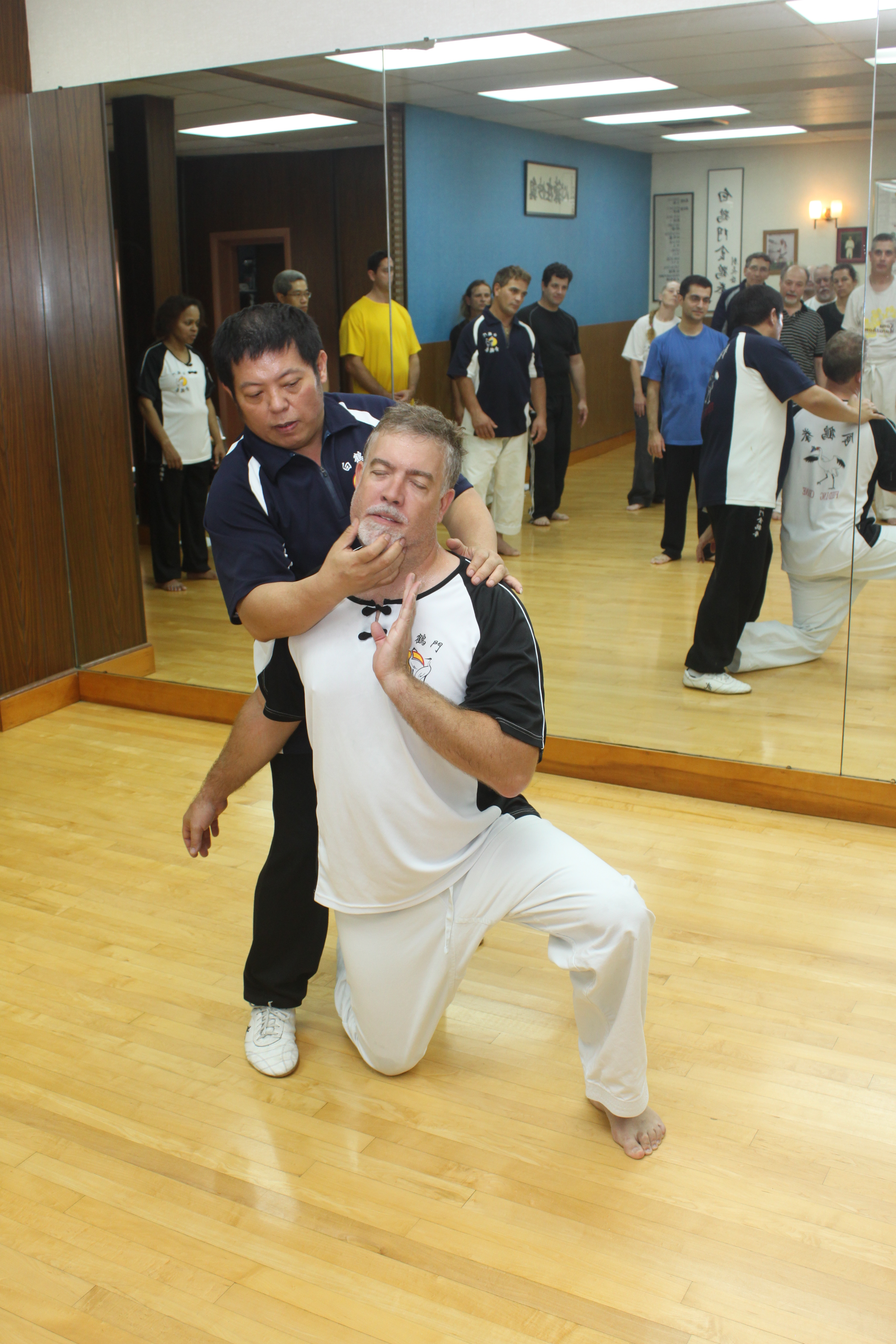
Basic application

Basic application principals

Sifu is now on his way back to Taiwan. We’ll see him again in the fall. In the meantime we’ll keep training together, and I may teach some Feeding Crane to a few groups that have shown interest, among them students at George Mattson sensei’s annual Summerfest. Hopefully we’ll see some of these folks come together for sifu’s next visit. Meanwhile the training is hard and continues to require me emptying my cup. But it is worth it. It is a fascinating system- among other things it has a clear teaching methodology for power and other attribute development and a vicious take on application that I appreciate. (To quote sifu: “we are Feeding Crane, we eat our opponents as our dinner”.) I also appreciate the friends that I have made through the practice and look forward to seeing them, and Liu sifu, again soon.

Park Training

A Saturday morning, good hard training, and perfect weather. What more can you ask for?

Fred & Corey in the park, about 2009

Fred & Corey in the park, summer of 2009

If you don’t train outside periodically, I would suggest you do. The dojo is good, but nothing beats training outside on a beautiful day.

Who Are Your Teachers?

A long-time student and friend is leaving the dojo this month. We’ve been training together for about 12 years and he and his wife are moving back to Sweden. He has been consistent, he trains hard, and he is one of the people I regularly see at the dojo working out before class. He has recently earned a well-deserved ni-dan, and continues to push himself and grow. I always look forward to his carefully thought out questions about training, and to the interesting conversations we have about history and politics. It has been a pleasure getting to know him, and he will be greatly missed.

I’ve been his teacher for a long time, and his leaving has me thinking about the role of a teacher, and who one’s teachers actually are. When I talk about my teachers I mention people like Kimo sensei, Sakai sensei, Gakiya sensei, and Liu sifu. But there is another group that often gets left out of lists like this. Most of my learning has been with the help of students who trained alongside me and, in more recent years, with the help of my own students. They are the people that I have worked out questions and problems with. The people I have done thousands of reps with, and whose questions have driven me to examine my practice, correct my mistakes, and keep learning. In a very real sense people like Corey, Mike, David, Shinji, Michael, Nagata, and of course Per have been the most important teachers I have had.

Per at Yoi

Per at Yoi

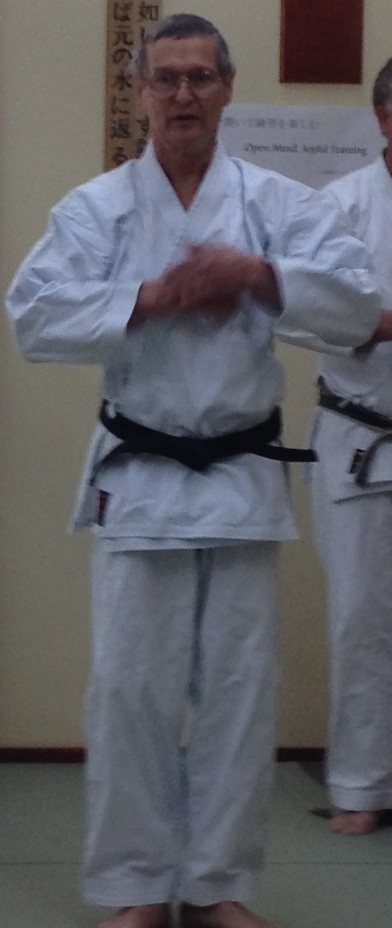
It is sometimes hard to quantify just what different people teach you. Per rarely misses training. When he does, it is usually because he has been doing a project at home and has either had  a minor injury or is completely worn out. Both his stories and the matter-of-fact way he delivers them have become part of our dojo lore. Some of my favorites include: “I shoveled an entire truck load of gravel into my basement through a window yesterday and my back is a little sore;” “I was replacing a beam in my basement and a steel plate fell on my head. I think I need stitches.” and most recently “I had oral surgery this afternoon. I wasn’t going to tell you because I figured I would be able to come anyway, but the anesthetic has me feeling off.”  I think it honestly does not occur to him that any of these are a reason to miss training until he gets up to go and realizes perhaps he needs to recover a bit more.

Training is holistic. It is partly about learning new material- mechanics, tactics, etc., but it is also about integrating what you bring to the table. One thing Per brings is that attitude. I  remember looking down a line of people doing body conditioning, contorted faces flinching at the pain of impact. Per was down the other end, a rather serene look on his face as his partner’s shin met his right thigh. His left was off limits due to a knee injury so he had his partner double up on the right. When we finished that drill he said “Are we done? OK. What’s next?” It never occurred to him not to come to training due to the injury, he just worked around it.

Per and Corey

Per and Corey

That attitude is something that is hard to cultivate. While we try to inculcate it in the dojo, it is also something Per brought with him. When he used to travel for work he would bring a step in his luggage so he could work out in his hotel room. That is the same thing: circumstances do not dictate what you can and cannot do, you do. Aside from details of technique and application, and from questions that have made me re-think what I thought I knew, this attitude is something that I have hopefully learned from him. It shows me he understands one of the core attributes of our practice.

I really hope I have an opportunity to introduce him to some of my friends and teachers in Okinawa someday. I think they would recognize kindred spirits in each other. Gibo Seki, for example, is 76 this year and trains every day. One afternoon in his dojo he removed his gi and his back was covered with analgesic patches- he had been helping install a floor the day before and his back was really sore. No reason to miss training though. Per started training with us when he was 62 and just turned 75. In our culture it is somewhat unusual for a person in their 70s to regularly do vigorous and hard contact training with people 30 years (or more) younger. Not so in Okinawa- most dojo are intergenerational spaces, and for good reason: the older teachers and students have a lot to teach the juniors, both in the art itself and in a more experienced approach to the process of training.

Gibo Seki sensei

Gibo Seki sensei

For Per, his age is just a circumstance and he trains without worrying about it. For me, it has been a benefit because, much like my teachers in Okinawa in their 70s and 80s, he is an example of what dedication and perseverance can accomplish. His hard and consistent training is something to aspire to, regardless of age. The disciplined and can-do way he approaches training is something else to aspire to. He trains hard, no caveats involved, and has no problem out-conditioning people 30 years his junior. He has also carefully adjusted his training over the years, keeping up the hard work but making sure he stayed healthy doing it. The lesson is simple- if you let circumstances dictate when and how you train, eventually you won’t be able to train at all. If you don’t there is no reason you have to stop. I plan to be doing this for the rest of my life, and he is one of the people who is teaching me how to do just that.

So we will miss him. The stories of why he might miss training. The can do attitude. The constant presence in the dojo, and the hard work he is always willing to do. It has been great training with him, and an honor being his teacher. He is part of our community and it will change without him. I know we’ll see him when he is back in the area and he will always be a member of the dojo. But it would be nice if he could still be here every day.

As I get a little older, and my training partners and students age along with me, it is easy to fall into the trap of “well, I’m not in my 20s anymore”. Sure, I’m not, and I would be foolish to try to train the same way I did then if I want to be able to train in another 20 years. But the next time I’m looking down a line of people in their 30s and 40s (or a little older) and someone notes that x was easier when we were 22, I won’t have Per sensei looking back, without saying anything, wondering when we youngsters were going to stop whinging and just get on with it.

Feeding Crane Seminar, June 2014

Hello Everyone,

Sifu Liu will be here next week! He asked me to say hello to everyone, and that he is looking forward to another visit to Boston, and to training and seeing everyone. We are looking forward to a fun seminar- good training and a group of good people to share it with. There is still space available if you would like to join us for the weekend, or just one day, so please get in touch if you do. As always, it promises to be an interesting, enjoyable, and sweaty weekend!

cheers,

Fred