As many of you already know, Kimo Wall sensei passed away on Thanksgiving. I have already written something about his history here, so I won’t be going into that again. While his death is not unexpected it is sad news. The last year plus had been very difficult for sensei and so I take comfort in knowing he is at rest. And yet, while I cannot speak for anyone else, the impact sensei has had on my life is difficult to even begin to assess and right now more than anything else I am sad, and wishing we could, once more, be sitting down to dinner after training together.
I first met sensei in 1986. I was 18, starting college, and knew nothing about martial arts. I started training and sensei introduced me to a path that has shaped my life. We shared travel together- around the US, in Japan, and in Puerto Rico. Countless meals, conversations, and so many shared friends and training partners. And of course countless hours in the dojo. He has been part of my life for over 30 years now and his passing, while not a surprise, somehow comes as one.
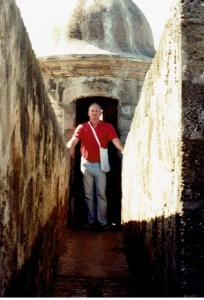
In El Morro, Old San Juan, late 1980s.
It is impossible to sum up a person, or more than 30 shared years, in a few words. I can’t really say much about sensei as a teacher or martial artist that has not already been said. Of course he was my teacher, and training with him taught me things I have taken into all aspects my life, lessons of perseverance, will, adaptation, and calmness that have served me well. But that is only a part of it. As he has passed I find myself thinking much more of the person, and our experiences together.
Mostly I find myself remembering little moments- sensei laughing when I dumped a straw filled with pickled jalapeno juice in Mike’s mouth when he was sleeping in a chair in Tennessee- sensei talking about his bulldogs, his “brother,” his family, his students- the deep respect and love he had for his teachers- sensei at dinner eating through what I thought was going to be a couple of days worth of sukiyaki lunches- listening to music together at a street party in Puerto Rico- him having a pan of brownies in his apartment in Japan when I arrived, saying “bet you haven’t had these in a while”- coming home to him parked in the driveway “hey hey Fred san, I am a few days (it was weeks..) early. What time is training and what’s for dinner?”. I find myself remembering his good humor, his occasional bad humor, his discipline and dedication, and what some people may not have noticed but how sentimental he was, and how sensitive to the relationships in his life.
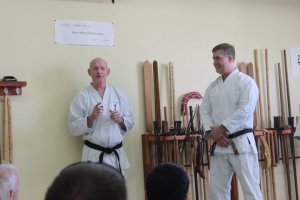
Opening the new dojo, 2009.
Of course there was training and the after-training lectures. Things like his taking my feet completely out from under me and the immediate “kamae!”, no break, no room for pause or even checking myself out- us working through part of papuhaku dai bunkai in the big gym in Totman. He hadn’t quite finished it yet, and it felt passing strange to be helping him work through a piece instead of just learning. (Help might be a strong word here, but he did ask me what I thought at one point.)- “ahm bah bunkai”- “you no be minus, you be plus”- struggles with “chicken fight bunkai” and a room of people in their 40s instead of college students- “sometimes demonstrations go well, sometimes they don’t, let’s eat.” But even in the dojo, right now my thoughts slide towards silly, personal moments. Yes, some are funnier in retrospect, but that too is a part of all that time.
One thing about all that time is that you come to know someone as they changed. He was not static. There was always something new. Even his last visit here held something I believe we could all learn from. I think we were the last dojo he trained and taught in, just a few days before his stroke. I truly wish I had been able to get him to go home to PR and rest, but he was adamantly having none of it. Instead, he was in the dojo, teaching and training. Utsu bo, kama (a terrifying moment with him, somewhat unsteady on his feet, holding a live blade between my legs to demonstrate a technique….) all sorts of karate and kobudo. At times he asked a student to help hold him up so he could demonstrate. What shone through was the passion. Regardless of his condition there was nowhere he would rather be than on the floor, with students and friends. But what is most important is that he knew it. This was where he wanted to be, what he was supposed to be doing. Do you know what you want so clearly?
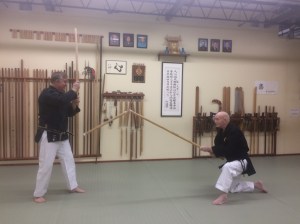
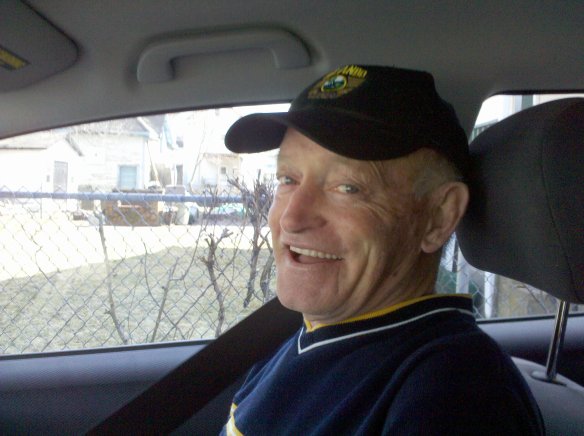
Smiling and training, of course. Spring 2017.
I will miss him, both the sensei I met in 1986 that scared the bejesus out of me when I came to kamae in front of him and the friend I would find sleeping on my couch in the afternoon when he was visiting, one eye opening and then dozing back off with a slight nod and a smile. He was a friend and teacher to many. Over the years and the miles many people had different experiences of him. Much of that I cannot speak to. He was a part of their lives and their practice. As a teacher and martial artist I know that the impact he has had on so many will be a lasting legacy that he can be rightly proud of. But that feels a little distant right now. For me, I will simply miss my teacher, and my friend.
Touguchi Seikichi sensei wrote this about the passing of his teacher, Miyagi Chojun. It seems fitting here.
A Tiger dies and leaves its skin
A Man dies and leaves his name
A Teacher dies and teaches death
And from a book that, for some reason, comes to mind I will leave you with this:
“I repeat again that first thing my teacher or my own madness revealed to me, on the cold stone flags of an ugly brick building, at the raw age of nineteen.
Death is before life and after it and in it all together, suffused with a light as perfect as the rays of the sun. It comes not an an insult, nor as a defeat, nor does it serve as a boundary to the free soul.”
Goodbye sensei. Aloha nui loa, and nifeedeebiru. Rest in peace.
 Kodokan Boston