Hakutsuru, the secret crane kata. Hidden knowledge, supposedly reserved for the highest level students of the Okinawan arts. Rare, deep, powerful. And yet, for all its vaunted rarity there is a plethora of “crane” in Okinawa. Seems every dojo or group has their “secret” crane form. I’ve seen dozens. Really. The forms have names like hakutsuru, kakuho, kakufa, hakkaku, paiho, hakucho, and so on, all essentially meaning “white crane” or “crane method”. Many seem to lead back to Gokenki, most likely a Ming He (Singing or Calling Crane) practitioner. (I recently wrote a little about him here.) Others are of less clear provenance. But really, it doesn’t matter. Why not? Because there is no crane taught in Okinawa. Yes, there are “crane” forms in Okinawa, but none are any different in how they are performed than the rest of the systems they are part of and none of those systems are crane.
Seems like a pretty strong position, given the status the “white crane” seems to hold in the Okinawan traditions. Especially in those systems like Goju or Uechi that claim a direct lineal connection to crane systems this connection takes on a power that is disproportionate to its historical weight; having a connection to “Chinese” roots can be a powerful piece of both social capital and historical validity in Okinawa. But there it is. Really. Regardless of the stories told, there is no crane taught in Okinawan karate. Perhaps I should explain why this is true. The answer is pretty simple. Energy and power.
Fujian’s White Crane systems use particular types of power generation and specific body energies. That sound esoteric but it isn’t, it just means they train one to move and hit in certain ways. Two of the most common of these are whipping and shaking. They are not present in Okinawan karate. Both of these in general require elements of movement that break fundamental karate rules. To whip you have to move your arms in curves, not lines, extend 100%, no holding back that little bit at the elbow, and drop all power at impact, so no kime. To shake you often have to lift your elbows instead of protecting your ribs, again use 100% extension, and you cannot chamber or “lock in” with kime. There are plenty of other mechanical reasons, those are just examples. There are also technical and strategic examples, as well as postural and movement examples, as well as training method examples, but this is enough for now. There are similar terms used- some Shorin schools “whip”, for example- but it is not whipping in the Crane sense.
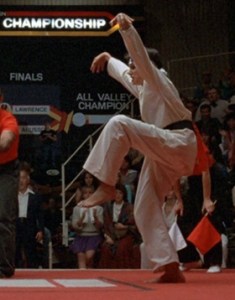
Crane Stance, No Can Defend
The point is (with the possible exception of Matayoshi Shinpo, a discussion for a different post) I have yet to see an Okinawan crane form being done with crane energy. Without the energy it is simply not crane. I think one real issue here is a basic misunderstanding of the place of kata, form. The reason the Okinawan crane forms are called crane is because they conform to certain ideas about what crane is. They look “crane like” with the open “wings” posture and finger tip and wrist techniques. Perhaps they are done “softer”, and usually contain one-legged “crane stances”. But the issue, at least from a crane practitioner’s perspective, is that these things have little to nothing to do with crane. Crane is about the power generation and strategy. The techniques in the forms are based on that, the crane is not based in the techniques. It doesn’t matter what it looks like, it matters how it is done.
So no crane. Okinawan karate with crane names, but not crane. To be clear, this isn’t bad. That would be like saying a Ferrari is bad compared to a Lamborghini. Both are pretty nice cars. They are just not the same car. Using Ferrari parts to repair your Lamborghini would not work well. Using karate energy to do crane technique works equally well. And vice versa. Thinking about The Secrets In Kata in this light, I think most of the “crane” forms in Okinawa are rather disappointing, at least if you are expecting special secret knowledge that will make you a more powerful martial artist. They don’t hold anything more than the karate systems they are a part of. They don’t really seem to add much. Except some cool factor, I guess. (Never underestimate cool factor…)
Of course that doesn’t take away from these systems! I love my Goju. It is a powerful and effective art. To return to the car analogy, I would be pretty happy driving a Lamborghini, and someone else driving a Ferrari doesn’t take away from how nice my car is, it just tells me there are other nice cars on the road. Okinawan karate has its own fundamentals, methods of power generation and movement, things that make it unique (in all its variation). Crane isn’t karate either! One is not better. But unfortunately that is part of the secret “crane”, the idea that it is somehow better. (An ancient Chinese secret.) Turns out this is an idea that is hard to defend, particularly when that crane is the same karate in a slightly different shape.
不抖不鹤
This is a saying from Ming He, Singing Crane. It roughly translates as: if it doesn’t shake/whip, it’s not Crane. It refers to the way Singing Crane (and, in my experience, Feeding Crane, albeit slightly differently) generates power, through variations on a shaking or whipping energy that is both highly distinctive and quite effective. The saying means that regardless of any other elements of practice, if you are not using this shaking/whipping you are not doing crane.
 Kodokan Boston