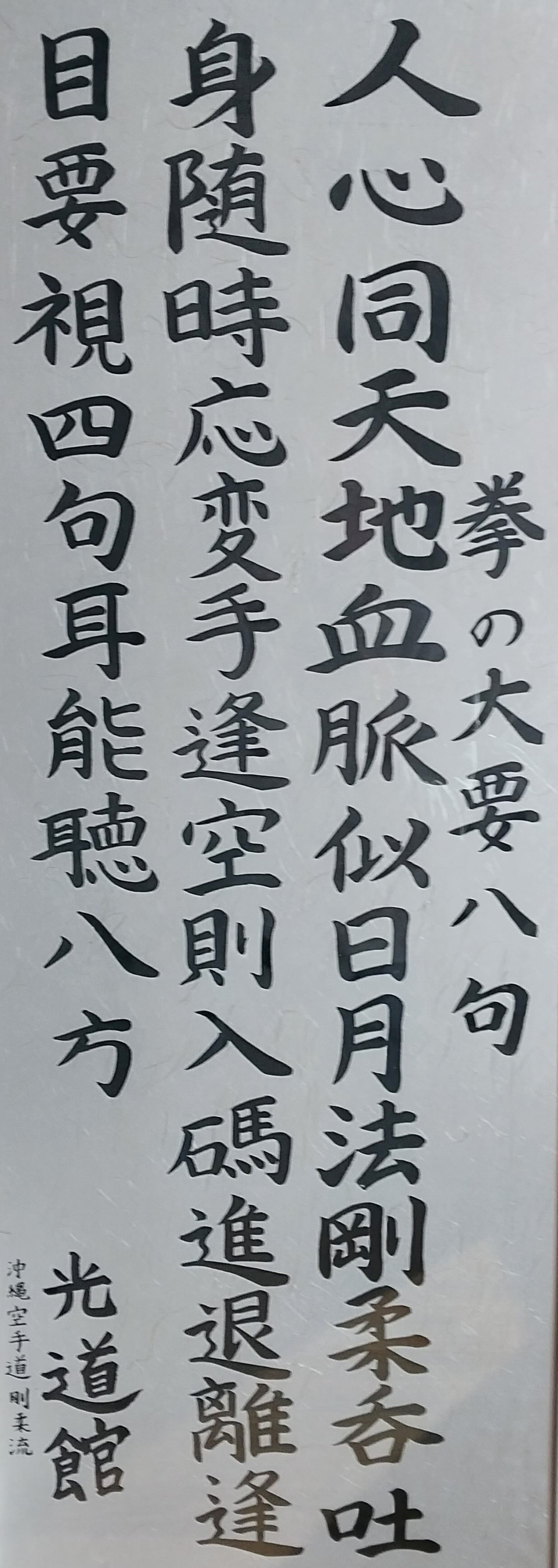
Culture, writing, language, training, they interact in interesting ways. The Water Margin translation I referenced in my last post reminded me of the Bubishi and the Kenpo Hakku, in particular the bit probably most connected to Goju Ryu’s history: 法剛柔吞吐; Ho Go Ju Don Tou. The characters directly translate something like- law/principle, hard, soft, swallow (in), spit (out). The form is a 5 character poem of a type common in Southern Chinese martial arts. They are sayings that elucidate elements of practice or the principles of the art. They can be difficult to translate because they are written without punctuation or much in the way of context, often missing particles, verb conjugations, subject and object markers, and other elements of language that could make them clear. More pertinently here, they also often reference cultural ideas or common use phrases that are very clear to a native speaker (or to an initiate) but may be completely unintelligible to a non-native. Think “bums me out” being translated by someone who has never heard the phrase before. Without knowing it means “saddens me” one might wind up with an odd-seeming translation that involves multiple posteriors, and potentially a lot of mystery.
In this case, there have been a lot of translations over the years. They usually focus on breathing, as the terms 吞吐Don Tou use characters that can be read to imply inhaling and exhaling as well as swallowing and spitting. So, translations like: The way of breathing is both hard and soft. With this translation, it makes sense to examine what the phrase means for using the breath in a hard or soft fashion, and what this then means for both practice and combative use. This is probably the right way to go, after all it is how the poem has been understood for quite a while, both on Okinawa and in the West.
However, there might be another, simpler answer to what this phrase means, one dependent on the cultural context it comes from. The Bubishi is a Southern Chinese Boxing manual, in a format fairly common in the area and time. These arts all use versions of: 浮沉吞吐FouChunTunTou, or: float, sink, swallow, spit. These are four basic directions of power- swallowing is drawing towards yourself or absorbing, spitting is sending out or projecting, floating is lifting or raising, sinking is dropping down or weighting. Obviously we could go into a huge amount of detail and discussion about these energies, what they mean, and how they are used, but that’s the basic idea. It is a core concept in these arts, in particular the Crane systems.
It seems perfectly in keeping for a Southern Chinese training manual to reference these energies. Almost mandatory. And certainly immediately clear to someone reading it. But it doesn’t seem that this phrase made it into the Okinawan arts with quite the same weight. It may be the Okinawans were not as familiar with it, or that it wasn’t as central to how they conceptualized their arts, and so the folks who trained in China didn’t really pass it on. Therefore, except to those who had trained in China and spoke the language, the very common meaning behind it may not have been apparent. This goes even more so for Western students working on translating from Japanese, as the Japanese is actually Chinese and not only is the phrase in another language, but it is actually a standard reference to something they may have had no context for and so didn’t recognize.
In short, Westerners (and possibly Okinawans?) may have been dictionary-translating a text that is structurally obscure without the key cultural context that could change it from something that seems esoteric into something simple. Indeed the phrase itself, instead of being an esoteric statement, could be a means of simplifying the Hard/Soft dichotomy that is so often used, giving it concrete examples as opposed to a more philosophical meaning.
If we look at it through this lens, instead of a commentary on breathing, you get a simple examination of two of the four directions of energy:
Rule (Ho) Hard (Go) Soft (Ju) Project/Spit (Don) Absorb/Swallow (Tou), just as before. But if instead of drawing connections to breathing through Don and Tou we think of them as common use terms for two of the four basic energies, the translation might be different.
Perhaps: The rule is projecting is hard, absorbing is soft. Or: be soft when absorbing, be hard when projecting. Or: When bringing in be soft, when forcing out be hard. Or: absorbing techniques are done softly, projecting techniques are done hard. Or: absorbing is a soft concept, projecting is a hard concept.
My experience in Feeding Crane, and limited exposure to a number of other Southern Chinese arts, tells me that these would all make immediate sense to someone who was trained in these systems, as these ideas- absorbing as soft, projecting as hard; connecting various energies to concepts of hardness and softness and then categorizing techniques based on them- are very common in these systems. Sometimes they are categorized something like: Swallowing is soft is pulling, defense, retreat, slow movement, reactive; Spitting is hard is pushing, striking, attack, advance, fast movement, aggressive. All ideas that can be easily connected to both training and use, are fairly concrete in meaning, and can be clearly linked to specific techniques.
Of course I can’t know if this is correct or not. I certainly am not about to dismiss the efforts in translation and understanding that have gone before me. But it does fit with the context the Bubishi is supposed to have come from. It also takes a lot of the woo-woo out of this portion of the poem, which I kinda like. Either way, it gives some context for what is often a very obscure section of text. If we are going to try to examine the connections between the Chinese and Okinawan arts we need to understand the context of both. Without context we are far more likely to be making things up as we go, which is cool, and can be fun, but perhaps isn’t the point?
 Kodokan Boston