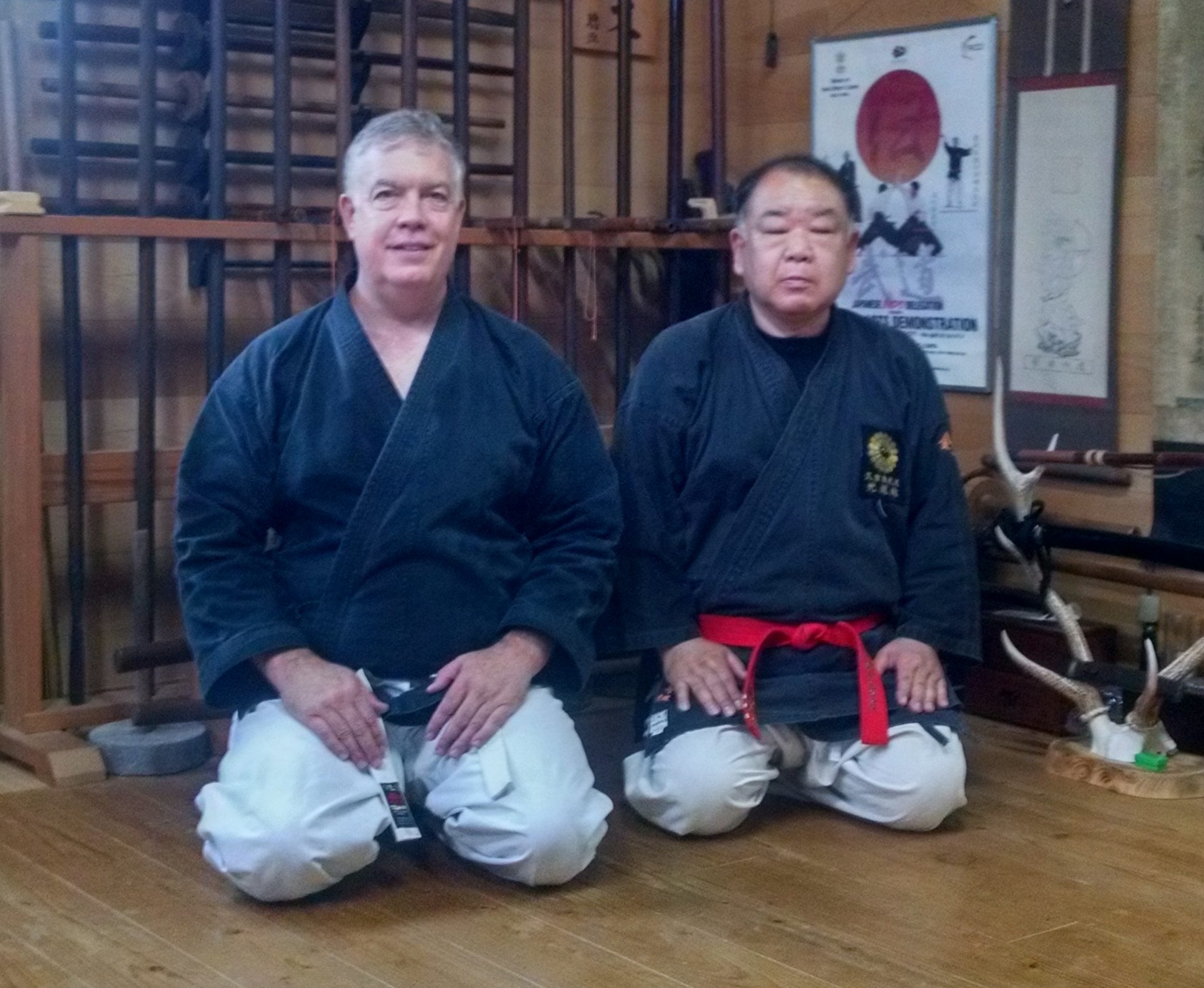
A few years back I made the acquaintance of Hayasaka Yoshifumi sensei. I was interested in meeting him because he was a close student of Matayoshi sensei’s in the 1970s and 80s, and had spent a lot of private time with him working on kobudo and elements of the family karate system (Kingai Ryu) and the Go Kenki crane system. Just before the pandemic I arranged to visit his dojo in Ibaraki prefecture and had a very nice couple of days doing karate and kobudo. I also found out he is the current (7th generation) Soke of the Negishi Ryu, the last remaining koryu bujutsu (classical Japanese warrior art) specializing in shuriken jutsu, the throwing and integrated use with other weapons of what are essentially metal spikes.[i] We did a little while I was there, but it was a few years before I was able to get back, in large part due to the pandemic. When I did, I realized I was enjoying the exposure to his understanding of our kobudo and karate, but I was finding the shuriken jutsu even more interesting. I asked him directly if he would be willing to teach me, and he said yes. It turns out it was time for something new.
We started with some basic techniques from the Shingetsu Ryu, a civilian system (or Ninjutsu system, depending on who is telling) currently held as a cognate discipline within Hayasaka sensei’s Negishi Ryu. He learned it from Saito Satoshi, his teacher, who learned it from Fujita Seiko[ii]. He felt it was a good introduction to shuriken, and also that both the technique and the weapon used were simpler. The weapon is more like a long nail or heavy needle than anything else. He gave me a couple and they were easy to replicate here. I introduced it to the dojo and a few members took to it quickly. I can’t say I am surprised- it is a lot of fun, and we’ve got a group of very dedicated practitioners, people interested in their practice and in learning new things.
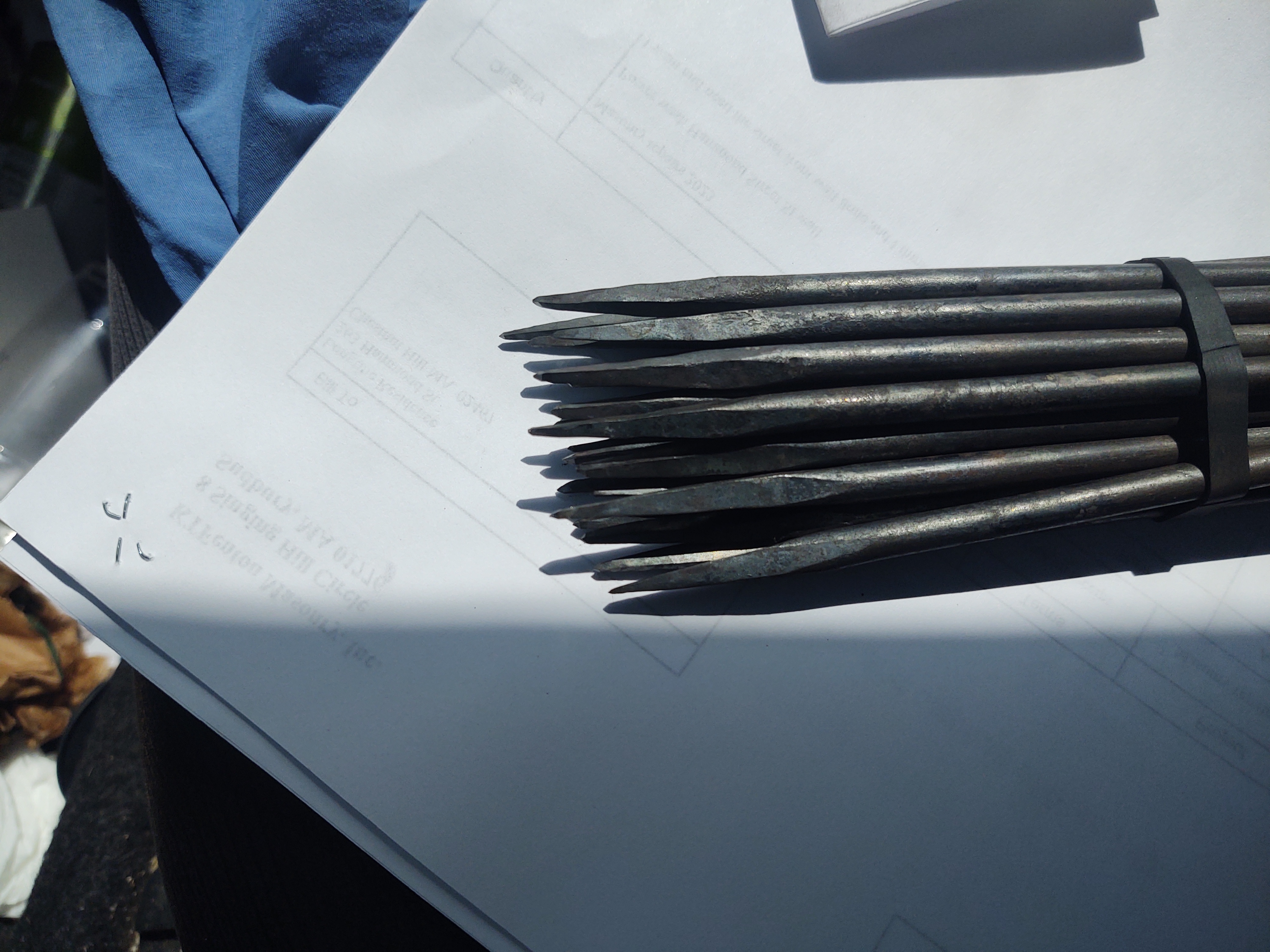
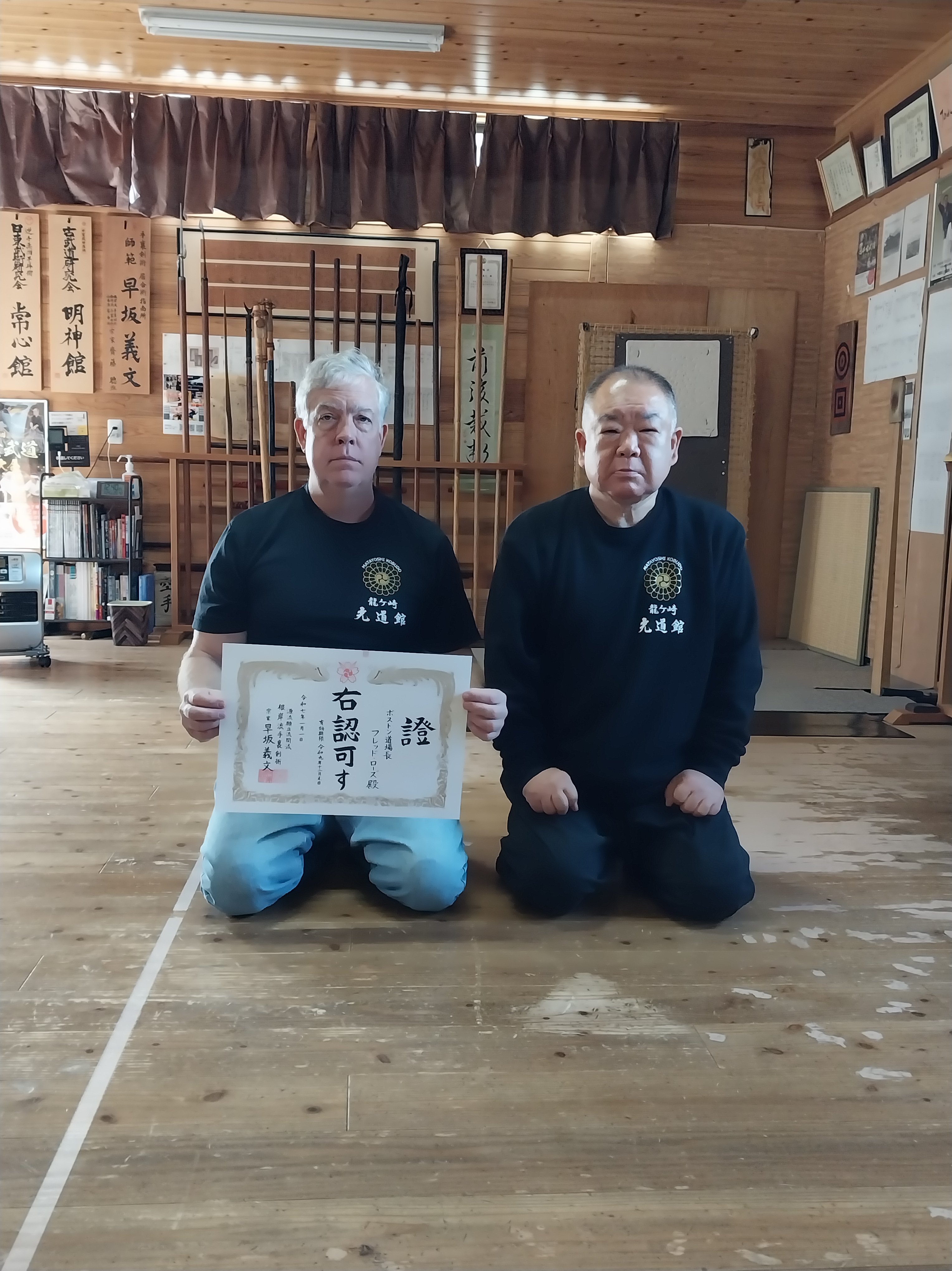
I have been able to visit Hayasaka sensei a few times in the last couple of years, and on the visit following he introduced me to the Negishi Ryu more formally. Indeed both the technique and the weapon, in this case a purpose forged octagonal, off center diamond tapered iron dart that is hand wrapped on one end with layers of paper, cord, and glue to create proper grip and balance, were much more complicated. He noted that this was a samurai art, with a different approach to technique and training, including integrating it with weapons like the sword, and allowing for a weapon that was both more expensive (they are hand forged by a specialist) and time consuming to obtain. In any case, it is equally fascinating and my experience of the practice so far has been both enlightening and great fun.

First, it is something new. While that in and of itself isn’t necessarily valuable it is one way to add energy and enthusiasm to your practice. If you have the right personality it is fun to start something and be really bad at it. If you stick to it you get to experience that initial growth in skill development, see your efforts paying off, which is hard to do if you have been at something for decades.
Second, it is fun. I mean that in part in the simplest sense: it is fun to take something sharp and throw it at a target and learn how to get it to stick, over time closer and closer to where you want it to. There seems to be something primal in that and since I was never that into any sport that used a ball I have had little experience with it before. So, fun both in the action and skill development (as well as in sharing this with friends). And finally it is fun, again for the right person, to see how something that initially seems pretty distant from our other practices is actually just another facet of them, lending a new perspective on certain elements of training- physical, mental, and tactical or theoretical.
It is this last bit that has been occupying some head space lately. This fairly simple (on the surface) practice is generating new insights into my existing arts. But how? After all, it is primarily standing (and eventually moving) and throwing a simple weapon at a target. Eventually that is integrated with various other weapons, but the practice pretty much remains solo (it is hard to throw sharp things at a training partner and have everyone keep training) and the scope of it remains fairly simple, albeit very difficult. So how does this art teach me about other elements of my training? Well, it is an ongoing process so these are just some initial thoughts, but I thought it might be interesting to share some of them here. In no particular order:
Fajing and telegraphing. Fajing is the term used in Feeding Crane and many Chinese arts for issuing short power. Striking with the shuriken (the systems both eschew the verbs for throwing, the reasons for which I am understanding more as I get more into the practice) requires using a very similar short power approach. This is tied very directly to not telegraphing one’s attack. These are not new ideas. Short power is common to many arts, and not telegraphing is a basic concept in every martial art and combat sport I have had exposure to. The sheer simplicity of the shuriken however highlights these twinned concepts. You cannot wind up, like throwing a baseball, if your opponent is fairly close and has a weapon. Telegraphing that strike gives the opponent an opportunity to close and cut you. But if you cannot strike with power and accuracy directly from your kamae your strike is useless anyway. In practice you need to be vigilant about making sure you are not telegraphing- not rocking back, not pulling the arm or hand back, not engaging your power chain in sections and adding internal wind up and therefore time to it, etc.. You also need to hit with some force. Doing both of these is directly related to how we are supposed to be moving and hitting in Goju, our Kobudo, and for me the most obviously right now Feeding Crane. It has been an interesting window on how fundamental to our tactics and strategy these two concepts are, and how assumptions around them are easily hidden, particularly in pre-arranged paired work.
Ma’ai and timing. Ma’ai is engagement range. We’ve all seen the data on how long it takes to get a weapon from its holster and engage. If I remember correctly about 26’ is the distance at which the weapon can be drawn on a charging attacker. Turns out people were figuring out what safe ranges for opponents with various weapons were hundreds of years ago too. These systems have concepts of what distances are appropriate for facing different weapons- unarmed, sword, spear, etc.- and what that translates to in regards to striking with the shuriken in that range. Again, much as doing say bo vs. sai paired work demonstrates the different ranges you need to move between more clearly than kicking vs. punching, this practice shows very simply the effect of range on time, and covers simple principles for managing that time/distance equation. It has been making me think a lot about distance and timing control in my other arts, as well as about how posture (mental as well as physical) and keeping the weapon, whatever it is, “live” affects this.
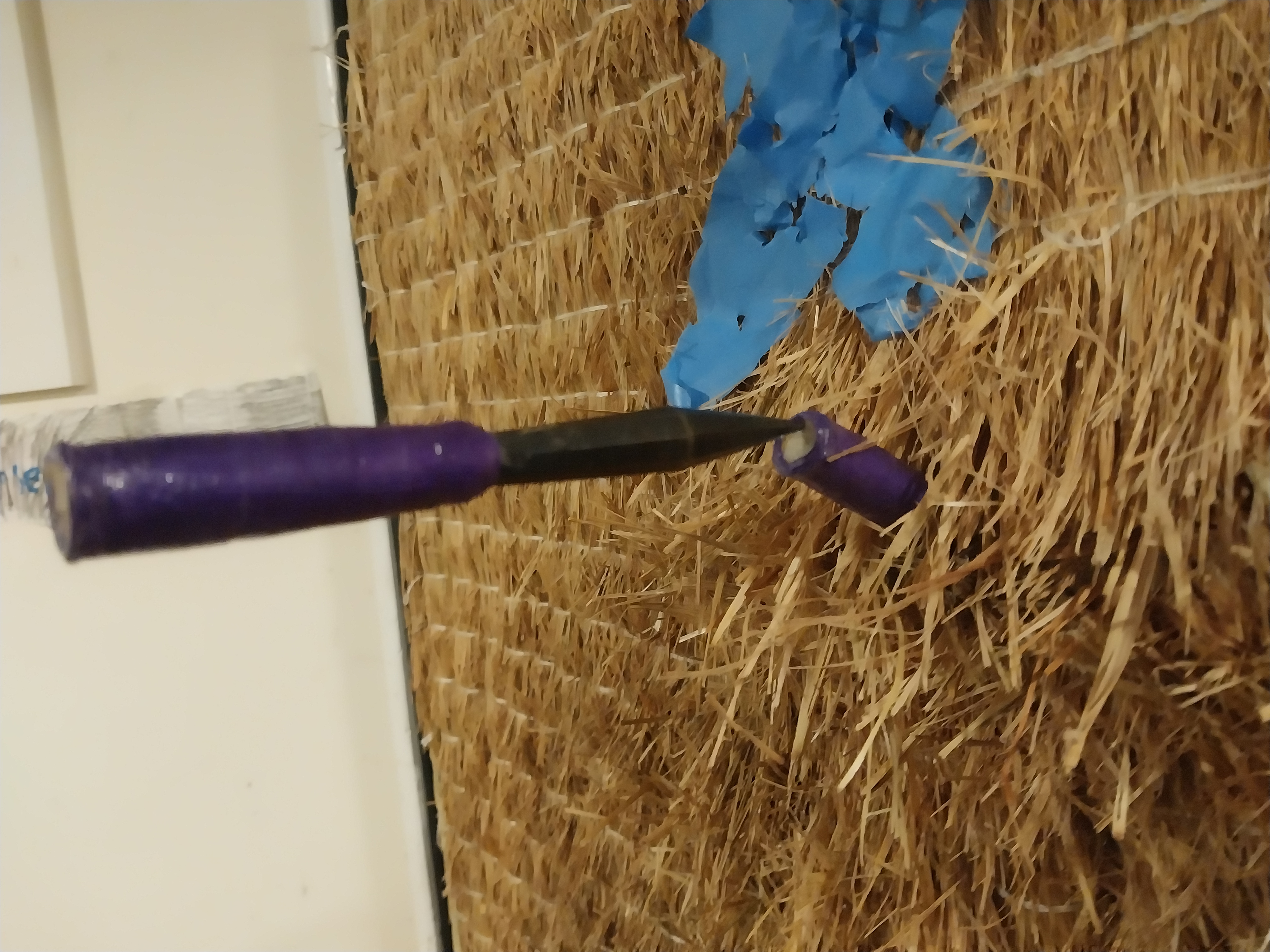
Concealment. I have mentioned this before in regards to the concealment built into the movement and techniques in both our kobudo and the empty hand arts we do. Here again it is in some ways simplified and highlit. The basic posture isn’t particularly sneaky, it is essentially a kenjutsu jodan kamae. However, if you are holding another weapon, or using your kamae in certain ways, the preparation of the strike, the shuriken kamae, and the following use of another weapon or drawing of another shuriken can be concealed by the movement itself, by your posture, or by the other weapon. Most of this is still above my pay grade, but I see how it is starting in the preparations and kamae and am looking forward to learning more. I am also finding how it is informing my other arts fascinating; I have long taught how certain elements of our movement and techniques conceal other elements of both intent and further movement but again the simplicity, and difficulty, of this art is making me see these things in a different light.
Focus and/or zanshin, mushin, and fudoshin. These mental states, keeping one’s focus on the task at hand, not being distracted either externally or internally, and maintaining those mental states as various things happen to or around one are again both simpler and clearer in this practice, at least to some extent. For example, it is easy to get encouraged or discouraged by hitting or missing what you are aiming at, or to set arbitrary goals and be attached to reaching them. It is easy to relax mentally between strikes or between sets, or as you change between people or gather your shuriken. It is easy to lose your posture, or kamae. It is easy to talk or look for suggestions or encouragement between strikes or sets of strikes. It is easy to let feelings of success, anticipation, or failure effect your next strike. To plan the sequence of your strikes. All these are true for any art, but the simpler format, and the really direct and immediate feedback it gives, can really highlight them. This feedback is both helpful and another potential mental hangup; you can see how well you are doing but it is really easy to get attached to that and let the emotions that come with not doing as well affect your technique, to limit yourself to what you can already do so you maintain a sense of success, or to get too attached to the goals you are setting and let the emotions that come with nearly reaching them, or not, affect your technique or state of mind. The importance of mental state on the practice is remarkable, and a huge insight into what it means in my other arts, though it can be harder to see there.
Anyway, these are a few of the things that are currently occupying me as I look at how this practice is both giving me insight into what I have been doing for decades and expanding my martial experience a bit. There are more, and I think they will continue to percolate and change over time. But right now I am grateful to Hayasaka sensei for taking me as his student in this art, excited about the practice and learning more of it for both me and our group, and just having fun. That last bit is often underrated in the martial arts. Everyone takes themselves so seriously sometimes. And being engaged in a koryu bujutsu is a serious thing, I don’t want to understate that. But it is also fun, and keeping that in mind for all our training is something else this practice is reminding me to do.
[i] There are a number of other koryu that include shuriken in their syllabus. Negishi Ryu is the only one extant that specializes in it, not the only one that includes it. There are also newer arts, like Meifu Shinkage Ryu, founded in the 1970s, that practice various versions of shuriken jutsu.
[ii] Interestingly enough, Shingetsu Ryu has a long connection with Ryukyu Kobudo. Fujita Seiko taught it to Inoue Motokatzu, Taira Shinken’s student, and it is passed down in his Ryukyu Kobujutsu Hozon Shinkokai. And though it is unclear if it was a specific system or who taught him, I am told Matayoshi sensei was skilled with bo shuriken. He was also sklled at throwing various other weapons in our system- sai and nunti sai of course but also kama and the paidao used with the tinbe. Having had some training in all of these I can see the connection.
 Kodokan Boston