A complete system?

So you train in a martial arts system. Ok. But what does that mean? Miriam-Webster defines a system as “a set of interacting or interdependent components forming an integrated whole”. That definition works pretty well for me. I think defining the concept of system in regards to a martial art is important, as there is a large difference between a system and a collection of techniques. A system implies a larger context- a tool that can be used to solve a variety of problems and a method for using that tool. Calling a martial art a system to me says a number of specific and important things.

First of all it says that there are rules to follow, for both training and application. In Goju concepts like “rise, sink, spit, swallow”, angular movement against incoming linear attacks, keeping the elbows in, all  both constrain and generate movement and application. These rules should be applicable to all elements of the system, they should be simple enough to learn quickly, and they should be easy to communicate. Then one needs to work on a deeper understanding of the system to see how these rules play out in different situations, how they generate answers to problems.

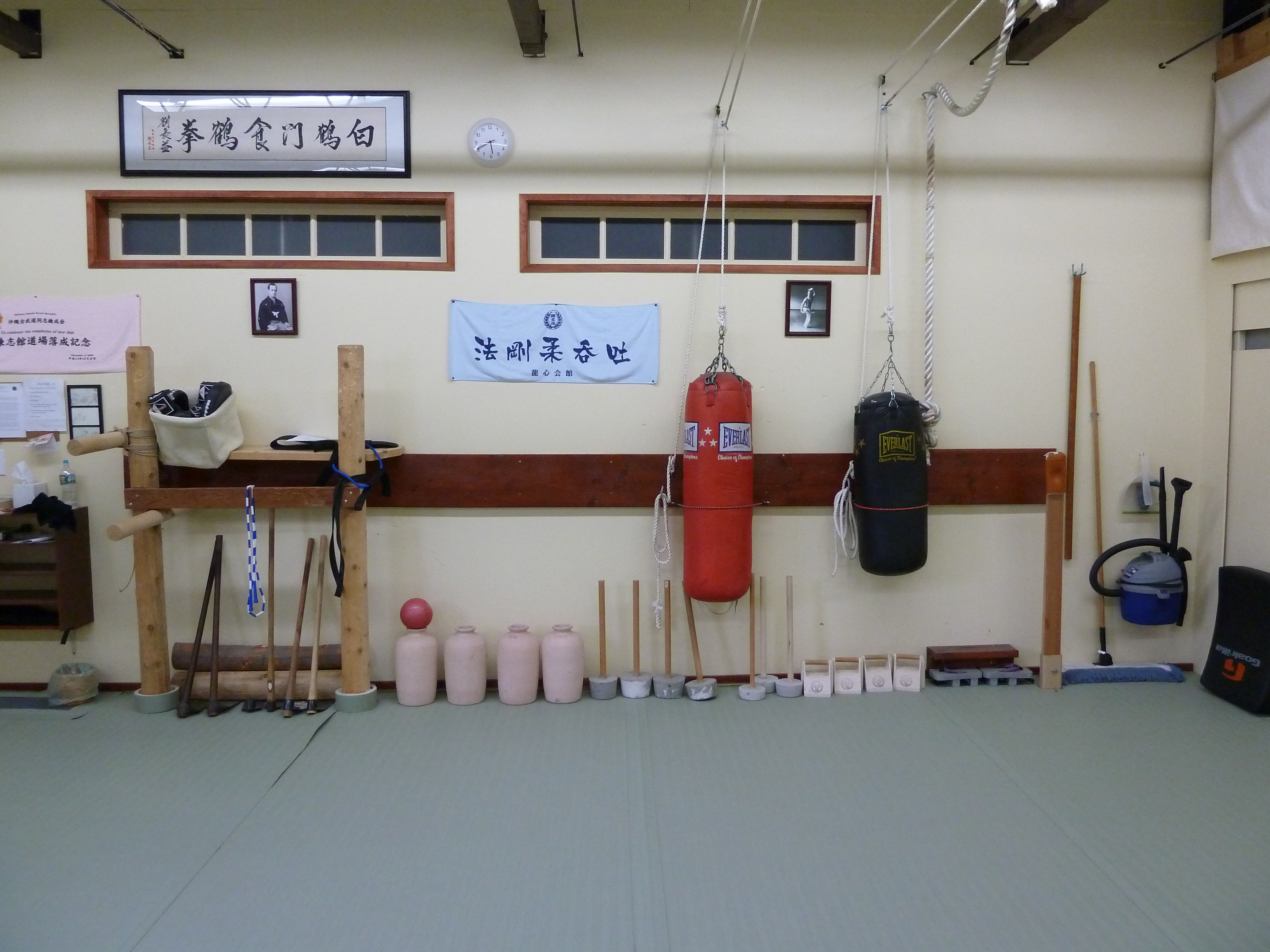
Second, it says there should be a reason for each part of the system, and you should be able to relate that piece to the larger whole. For example in Goju Ryu we have a variety of supplementary exercises, like work with the chishi or tetsu geta. These certainly improve fitness, but that is not their point. Instead, they develop specific muscle groups and connections (as well as breathing, etc.) that support the techniques of the system. If you cannot relate the exercises back to fairly specific elements of the system’s application, it is probably a good bet you don’t really understand their purpose very well.

This is consistent for all elements of the system. The stances support the tactical choices. The power generation supports the techniques used. The techniques support the strategy imbedded in the system and its kata. These are all interrelated- each part supports others, and practiced properly they create a unified whole.

So, thirdly, it says that since the parts are not stand alone items to understand them you need to have some understanding of how they fit into the whole. Using Goju Ryu again we have a practice called kakie, a form of push hands. I often see it done very hard, almost as strength training. When I see It done that way I know that the teacher does not really understand it. Kakie is an interactive practice. It develops sensitivity to your opponent and control of their center, among other things. The system has other methods of strength building. But without an understanding of the whole it is easy to apply inappropriate emphasis to the components. It is like using a chisel as a screwdriver. It works but it is not the right way to use the chisel and can leave the chisel unusable for its proper job.

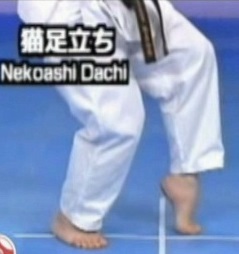
Fourthly it says that details matter. Small details can make a large difference, but they must be understood to be trained properly. Various Okinawan systems use a neko-ashi dachi, often called a “cat stance”. In it the weight is primarily on the back leg, the butt is stuck out a bit, the shoulders are over the hips, and the front heel is raised slightly. But if the shape is all you understand it is easy to emphasize appearance over content. I often see the front heel lifted sharply or the toes pointed. While that may look nice it creates tension in the calf and possibly around the knee and hip joints that changes the weight distribution and slows down the leg for both kicking and moving. This contradicts the reasons for using the stance. You need to understand why things are being done to train them without devolving into stylization over function. The details are in the function, not the appearance.

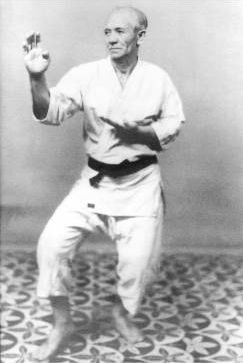
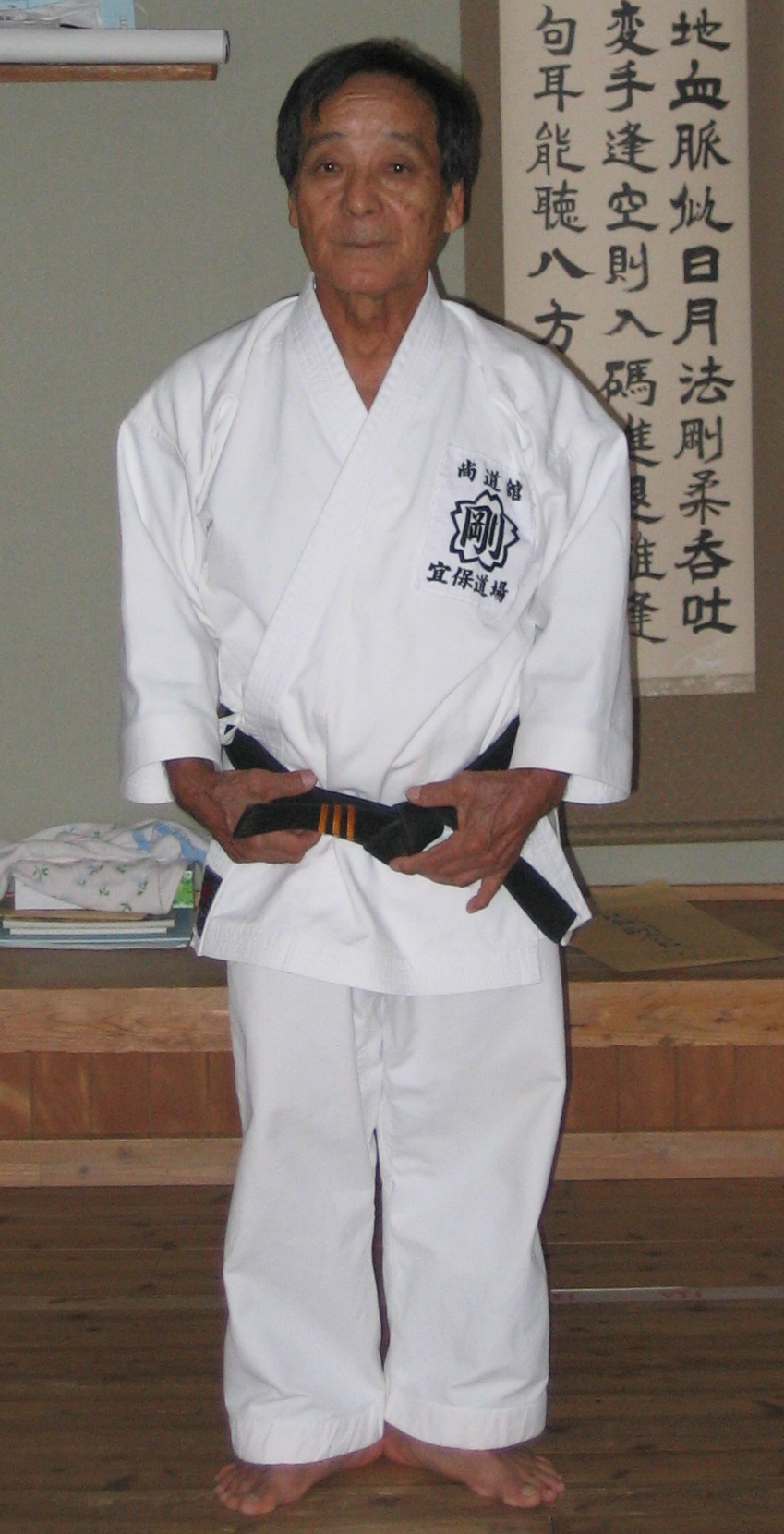
Higa Seiko
Higa Seiko

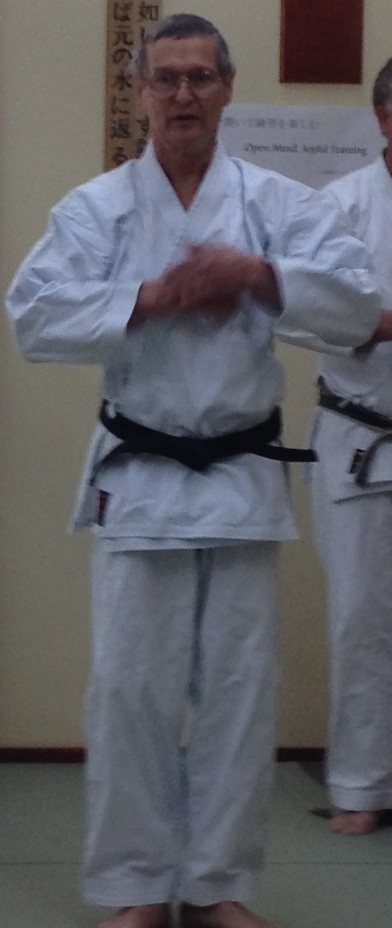
Nekoashi


Therefore, and fifthly, it means you have to be very careful about adding, removing, or changing the parts since the influence of changes on the gestalt of the system is often hard to see. For example in the Shoreikan lineage of Goju Ryu there are 10 toitsu fukyu (standardization and dissemination, often called “training”) kata, like gekisai, gekiha, etc..  Most have accompanying paired sets which generally position opponents directly in front of each other. Toguchi sensei said that he added them to make learning Goju easier (among other things) and because Miyagi sensei had said that was how he wanted the system to develop. But because of how they move they train people to stay directly in front of their attacker. This is contrary to the basic tactics of Goju, making many parts of the system ineffective and therefore, in my opinion, denatures the system. Good intentions can have unexpected consequences.

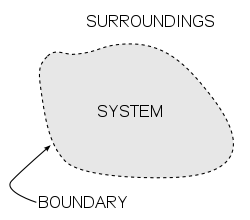
Finally, a system has boundaries, parameters. These systems were designed by people, not gods, and are finite. I think that is a good thing. Too many options is more likely to lead to a freeze than a good solution. In our kobudo I joke with my students that we really only have 5 or so techniques. That is because the same mechanics and concepts are used over and over again. It creates in some ways infinite variation, but in a very simple fashion. For example we use the same mechanic for a naname uchi with a bo, with sai, or with any other weapon. This can be hard to see, as the shifts demanded by the different tools can easily mask the commonality of the mechanics if you don’t have a good overview of them. But they are not hundreds of different techniques, they are just a few adapted to different circumstances. When I see different weapons or techniques taught in a format that requires memorization of dozens or hundreds of separate items I see that either the teacher does not understand the system or there is no system, just a collection of techniques masking as one.

This last can really trip people up. Martial arts are full of assumptions, and of fantasy. Many people have an image of what a system holds. A “complete system” is sometimes defined as containing striking, grappling, groundwork, and (sometimes) weapons. I find that an interesting definition, as it gives a list of components but does not address system as a concept. Indeed, not all systems will conform to what people wish for. For example I once helped teach a class at the Kaosiung Police training center with Liu sifu. Afterwards he got a variety of questions. One was about how to use Feeding Crane to safely subdue or control a subject, something very pertinent to the police officers present. Sifu’s answer was enlightening: “Someone asks me this every time I come here. I don’t know. Feeding Crane does not have subdual or control techniques, we practice quickly causing a lot of damage to the enemy. I can’t teach you how to just control with Feeding Crane.”  Since it is a bad idea for police officers to severely injure, blind, or kill someone they are arresting, the answer was not that satisfying for some of the people present. But that does not mean that Feeding Crane is not a complete system, it means that that system’s boundaries didn’t contain what the questioner wanted. That is not a fault of the system. Our bodies do not have gills. Personally, I find this frustrating, as I would really love to be able to dive without SCUBA gear. But that is not what this system contains, so I’m stuck with it.
250px-System_boundary.svg

So the definition of system in the martial arts is very important. It is not something that includes what a given person thinks they need. It is not a list of components at all. It is the concept behind the practice, whether or not the practice is a unified collection of training and application methodologies that, working together, generate a simple and consistent way to solve the problems it was developed to solve. This is very different from a collection of techniques. A collection of techniques implies that you have to collect specific solutions: if a person attacks this way, do this then this. A system means that the body and mind are being trained to generate solutions on the spot, instead of needing to have one pre-made.

My experience of classical martial arts systems (Goju, Feeding Crane, Jigen Ryu, among others) tells me that they are strict In their details for reasons beginners often cannot see. The gestalt of the system takes a while to open itself up to a serious practitioner and changes to that gestalt can prevent the system from working well. A poor student, a poor teacher, or, and they certainly do exist, a poor system, and a good result may never come. But if the student works hard, the teacher has the background to convey, and the system is good, they create possibilities that a collection of techniques, no matter how interesting, never can.
Crane Drinks From Empty Cup

It is definitely a season for seeing teachers and friends! Over the last few months I have been in Japan and Okinawa, had a good visit from Kimo sensei, and most recently have hosted Liu Chang’I sifu. It’s been busy, but great fun! Sifu came for a short visit this time, but it is always good to see him. When he comes he stays with me, we train and talk about his art, eat too much duck, and have a weekend seminar. I met him in 1996 when he was visiting the US for the first time with Kimo Wall sensei. It was a good meeting and he taught a few of us some of the basic power development exercises from the system. We practiced them but it was over 10 years before we saw him again. He asked about the “thunder power” and where we had gotten with the ji bei gong he had shown us and was surprised to hear we had not got much result from them. Then he took a closer look and said simply: “oh, yes. You are doing them wrong. You will never get thunder power that way.” That started was has become a more in-depth practice of the art in the years since. I have hosted him here every year and have visited him in Taiwan to train. His visits are always fun, and the seminar we do here in Boston is a great time- we have interested and dedicated practitioners from a variety of arts that come together to train and touch hands. Hard training and good spirit!

The seminars are great, and a good opportunity to get a “taste” of the system. But when we do have them it also makes me think about how hard it can be to learn much in a couple of days. We train hard, and sifu is very open with his instruction and advice. You can certainly come away with something to practice. But I can’t help but get reminded of 10 years spent sort of doing the exercises and getting little result. Things like the ji bei gong from the Feeding Crane can seem very simple. They are not very complex movements. Most are done in a standing position, in one of three stances, and some use a single turn or a simple triangle step. But do them improperly and you get little out of them. You can even hurt yourself doing them if you do them wrong. Most importantly, you must practice them using the framework they were developed in. One of the biggest mistakes I was making when I first did them was applying Goju “rules”. For example in a number of the Feeding Crane movements the elbow joint is fully extended, 100%. That allows the arm to transmit energy in a way that it cannot if even slightly bent. In Goju we rarely if ever lock out that joint- it is considered bad mechanics and bad tactics. Neither is correct, both are right in the appropriate context. But apply one rule to the other system and you get a poor result.

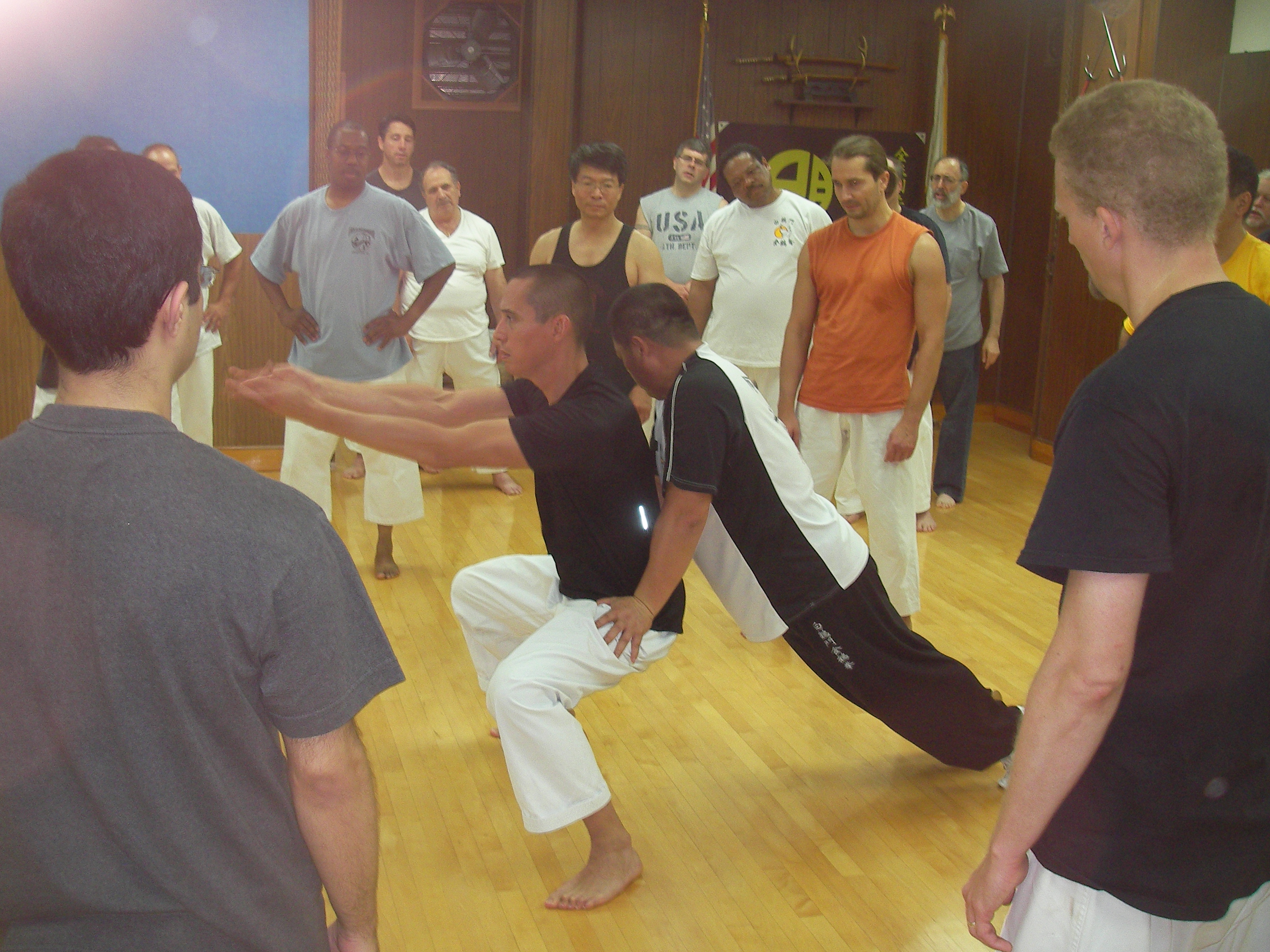
Sifu checking ma bu

Sifu checking ma bu

Much martial arts training is that way. It can seem simple, but proper instruction is required. Many of the important details are difficult or impossible to see if you are not told what to look for, and observation and correction from someone who understands both how to do and how to teach is essential. This is particularly true if you have experience in a different art- many of your “rules” will have become habit, and you may not even know you are following them. In my case, a few simple corrections and by his next visit some “thunder” was emerging. But to get there I needed both the corrections and the hard work that followed them. I needed to empty my cup and engage with a new system; if I had decided what I already knew was right and that I should not lock out the elbow, for example, I would still be getting poor results. So I had to admit that what I already knew may not have all the answers. In the process I’ve also learned a new appreciation for the “rules” of Goju, how they affect mechanical and tactical choices, and that I need to empty my cup there too. Win-win, really.

Seeing and training with sifu reminds me of that. It has also just been good to see one of my teachers again. Liu sifu is very personable, cares a great deal about both his system and his friends, and has a lovely family. I like spending time with him. That is important to me on a very fundamental level. His art is impressive. I have been around the martial arts a while now, and I have yet to see anyone else who is capable of delivering his power at such close range with such rapid succession. His methods work and I always learn something from him. But honestly if he was not a good person I would not be training with him. I have a full life, and no space in it for jerks. Unfortunately you see a fair number of those in the arts, but Liu sifu is not one of them. He is a great guy.

He is also very open with his knowledge, and wants to share it with anyone who is interested. That is something I have tried to keep part of our crane practice here. Members of our dojo and  Anthony Mirakian sensei’s Meibukan dojo get together every two weeks to train. Our versions of Goju are slightly different, but the spirit is the same. Mirakian sensei’s students have an excellent teacher, and it is great fun to train with them; they have a strong base, work hard, and have a really good attitude. Good people, and I am lucky to have been able to train with them the last few years. It is a rare opportunity to make some martial arts friends, and to touch hands with other people, and I look forward to it every time. In fact, over the years Mirakian sensei has been very generous to us. He has allowed me to teach his students in his dojo, which is very good of him. He has had us use his dojo both for our bi-monthly training sessions and for hosting the seminars and the closed training our two groups do when sifu is here. He has also hosted some very nice dinners for people participating in the annual seminars, and they have been great evenings. It is clear to me that he sees the value in sifu’s art, and in all of us coming together to practice it. I do too- it is such a good feeling to see people working together to share, sweat, and train!

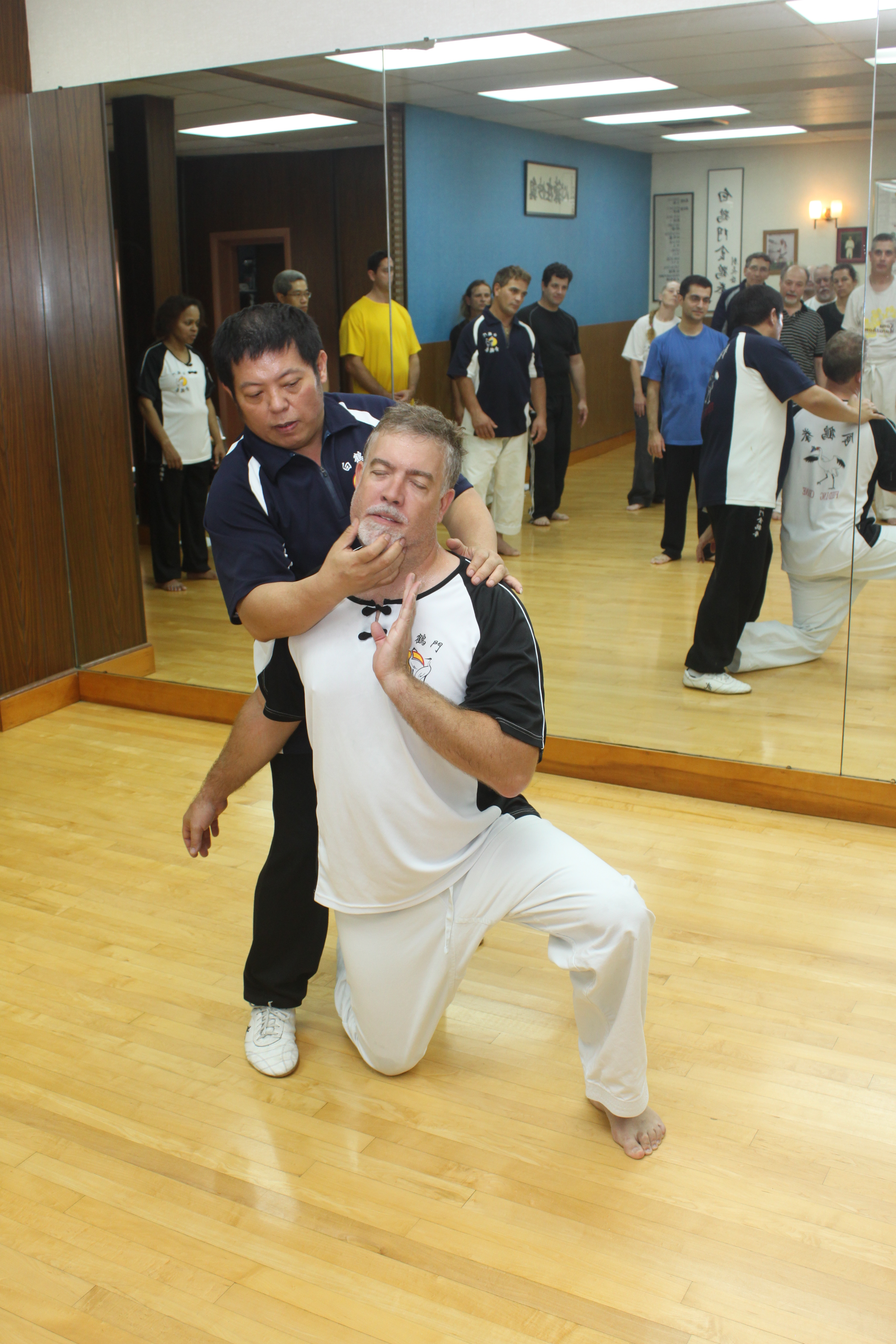
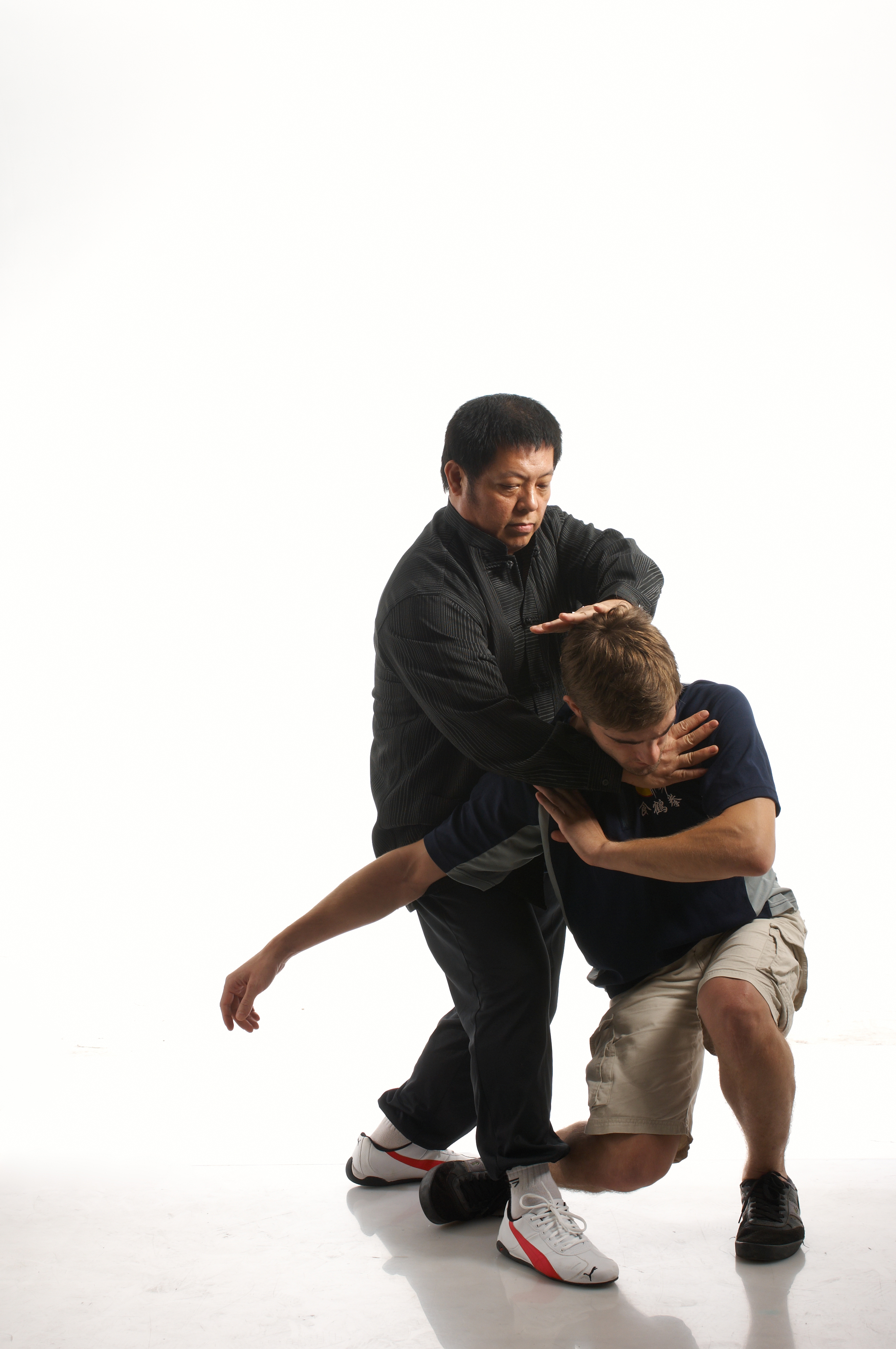
Basic application

Basic application principals

Sifu is now on his way back to Taiwan. We’ll see him again in the fall. In the meantime we’ll keep training together, and I may teach some Feeding Crane to a few groups that have shown interest, among them students at George Mattson sensei’s annual Summerfest. Hopefully we’ll see some of these folks come together for sifu’s next visit. Meanwhile the training is hard and continues to require me emptying my cup. But it is worth it. It is a fascinating system- among other things it has a clear teaching methodology for power and other attribute development and a vicious take on application that I appreciate. (To quote sifu: “we are Feeding Crane, we eat our opponents as our dinner”.) I also appreciate the friends that I have made through the practice and look forward to seeing them, and Liu sifu, again soon.

Park Training

A Saturday morning, good hard training, and perfect weather. What more can you ask for?

Fred & Corey in the park, about 2009

Fred & Corey in the park, summer of 2009

If you don’t train outside periodically, I would suggest you do. The dojo is good, but nothing beats training outside on a beautiful day.

Who Are Your Teachers?

A long-time student and friend is leaving the dojo this month. We’ve been training together for about 12 years and he and his wife are moving back to Sweden. He has been consistent, he trains hard, and he is one of the people I regularly see at the dojo working out before class. He has recently earned a well-deserved ni-dan, and continues to push himself and grow. I always look forward to his carefully thought out questions about training, and to the interesting conversations we have about history and politics. It has been a pleasure getting to know him, and he will be greatly missed.

I’ve been his teacher for a long time, and his leaving has me thinking about the role of a teacher, and who one’s teachers actually are. When I talk about my teachers I mention people like Kimo sensei, Sakai sensei, Gakiya sensei, and Liu sifu. But there is another group that often gets left out of lists like this. Most of my learning has been with the help of students who trained alongside me and, in more recent years, with the help of my own students. They are the people that I have worked out questions and problems with. The people I have done thousands of reps with, and whose questions have driven me to examine my practice, correct my mistakes, and keep learning. In a very real sense people like Corey, Mike, David, Shinji, Michael, Nagata, and of course Per have been the most important teachers I have had.

Per at Yoi

Per at Yoi

It is sometimes hard to quantify just what different people teach you. Per rarely misses training. When he does, it is usually because he has been doing a project at home and has either had  a minor injury or is completely worn out. Both his stories and the matter-of-fact way he delivers them have become part of our dojo lore. Some of my favorites include: “I shoveled an entire truck load of gravel into my basement through a window yesterday and my back is a little sore;” “I was replacing a beam in my basement and a steel plate fell on my head. I think I need stitches.” and most recently “I had oral surgery this afternoon. I wasn’t going to tell you because I figured I would be able to come anyway, but the anesthetic has me feeling off.”  I think it honestly does not occur to him that any of these are a reason to miss training until he gets up to go and realizes perhaps he needs to recover a bit more.

Training is holistic. It is partly about learning new material- mechanics, tactics, etc., but it is also about integrating what you bring to the table. One thing Per brings is that attitude. I  remember looking down a line of people doing body conditioning, contorted faces flinching at the pain of impact. Per was down the other end, a rather serene look on his face as his partner’s shin met his right thigh. His left was off limits due to a knee injury so he had his partner double up on the right. When we finished that drill he said “Are we done? OK. What’s next?” It never occurred to him not to come to training due to the injury, he just worked around it.

Per and Corey

Per and Corey

That attitude is something that is hard to cultivate. While we try to inculcate it in the dojo, it is also something Per brought with him. When he used to travel for work he would bring a step in his luggage so he could work out in his hotel room. That is the same thing: circumstances do not dictate what you can and cannot do, you do. Aside from details of technique and application, and from questions that have made me re-think what I thought I knew, this attitude is something that I have hopefully learned from him. It shows me he understands one of the core attributes of our practice.

I really hope I have an opportunity to introduce him to some of my friends and teachers in Okinawa someday. I think they would recognize kindred spirits in each other. Gibo Seki, for example, is 76 this year and trains every day. One afternoon in his dojo he removed his gi and his back was covered with analgesic patches- he had been helping install a floor the day before and his back was really sore. No reason to miss training though. Per started training with us when he was 62 and just turned 75. In our culture it is somewhat unusual for a person in their 70s to regularly do vigorous and hard contact training with people 30 years (or more) younger. Not so in Okinawa- most dojo are intergenerational spaces, and for good reason: the older teachers and students have a lot to teach the juniors, both in the art itself and in a more experienced approach to the process of training.

Gibo Seki sensei

Gibo Seki sensei

For Per, his age is just a circumstance and he trains without worrying about it. For me, it has been a benefit because, much like my teachers in Okinawa in their 70s and 80s, he is an example of what dedication and perseverance can accomplish. His hard and consistent training is something to aspire to, regardless of age. The disciplined and can-do way he approaches training is something else to aspire to. He trains hard, no caveats involved, and has no problem out-conditioning people 30 years his junior. He has also carefully adjusted his training over the years, keeping up the hard work but making sure he stayed healthy doing it. The lesson is simple- if you let circumstances dictate when and how you train, eventually you won’t be able to train at all. If you don’t there is no reason you have to stop. I plan to be doing this for the rest of my life, and he is one of the people who is teaching me how to do just that.

So we will miss him. The stories of why he might miss training. The can do attitude. The constant presence in the dojo, and the hard work he is always willing to do. It has been great training with him, and an honor being his teacher. He is part of our community and it will change without him. I know we’ll see him when he is back in the area and he will always be a member of the dojo. But it would be nice if he could still be here every day.

As I get a little older, and my training partners and students age along with me, it is easy to fall into the trap of “well, I’m not in my 20s anymore”. Sure, I’m not, and I would be foolish to try to train the same way I did then if I want to be able to train in another 20 years. But the next time I’m looking down a line of people in their 30s and 40s (or a little older) and someone notes that x was easier when we were 22, I won’t have Per sensei looking back, without saying anything, wondering when we youngsters were going to stop whinging and just get on with it.

Feeding Crane Seminar, June 2014

Hello Everyone,

Sifu Liu will be here next week! He asked me to say hello to everyone, and that he is looking forward to another visit to Boston, and to training and seeing everyone. We are looking forward to a fun seminar- good training and a group of good people to share it with. There is still space available if you would like to join us for the weekend, or just one day, so please get in touch if you do. As always, it promises to be an interesting, enjoyable, and sweaty weekend!

cheers,

Fred


More Old Friends

So it seems like this is a time for seeing old friends and teachers. I started training Goju Ryu and Matayoshi lineage kobudo early in 1986. I was a new student at UMass Amherst, and Kimo Wall sensei was teaching there. To be honest, I chose my first karate class based on schedule. I knew nothing about karate, except what I had seen in the movies, and I thought it would be cool to learn. There were other karate classes at UMass; knowing what I know now about the quality of that instruction I believe that if I had taken one of those classes I wouldn’t have continued. Instead, I happened into Kimo sensei’s class, and started on a path I still travel. I trained under him, in that class and then in daily club practices, until he moved in 1989. Now I see Kimo sensei just about every year. It is always good to see him, and I always learn something.

The dojo here will be 25 years old next year, and we have had a lot of people through it in that time. Some were originally students from UMass. Priorities change and not everyone keeps training, but one of the best parts of sensei’s visits is the old friends that come out to see him. These are people I sweat (and occasionally bled) with. We shared a part of our lives and it is always good to see them. Of course a large part of sensei’s visit is training time, but equally important is seeing these old friends. It is something of a theme in my posts lately, but I believe the relationships we develop around our training are at least as important as the training itself.

With Kimo sensei, May 2014

With Kimo sensei, May 2014

Why? On a practical level, training takes close personal interaction. If you don’t have long, strong relationships in the dojo, it is hard for me to see how you can possibly have learned much from your teacher. To get through the foundational movements and into the meat of practice takes time. The practice can be dangerous, so it also takes trust. When I see people who have switched teachers every few years, or who have a lot of seminar instruction in their “resume”, I have to wonder: do they really know much? Because they probably have not had the opportunity to learn.

Some people feel Kuden, or oral teachings, are secrets. Nonsense. They are what I call proper instruction. Of course your kuden are oral- your teacher tells them to you. Of course they only get revealed at certain points- a good teacher gives students information that will help at the right time. And of course they don’t get shared with everyone. Passing on the details of one’s art is a personal thing. If I know you, see you share a passion, have discipline and dedication, and I respect you, I will give you everything I can. But if I don’t know you why should I share what has taken me decades of time, effort, and treasure to learn? For money? I don’t think so. Kuden are personal training tips, details that make the waza work, context. They are passed down or learned through hard work. Who is going to share them with someone they don’t know?

That does not mean that you and your sensei need to be best buddies. But it does mean you get to know each other. Kimo sensei and I have known each other since I was 18 (and he was younger than I am now). We share a fair bit of history. Do we always see eye to eye? Probably not. But we respect each other. A lot of the “kuden” he has shared with me have not been in the dojo. They have been over chicken and rice in San Juan, or in his living room in Yokota, or after breakfast in my kitchen. Places we would not have been if I had started studying with him last year, or we had just met at a seminar.

So for training purposes, these relationships are important. But that is only the beginning, in my opinion. Who besides family have you kept in your life for 20 or 30 years? One of the things that I find invaluable about training is that when you find people to share the passion of our practice with you may also find friends, the kind of friends you will still be sharing your life with decades from now. These relationships are rare.

Kimo sensei spent about a week here, and he is off traveling around the US again. It is always great to see him. He was my first teacher, and I have him to thank for my introduction to the arts. When he is here we share old stories and see old friends. We train, and I get some insight on the dojo here and our practice. But most importantly we get to renew these relationships, take time together and with other friends from the dojo. Seeing him reminds me to be glad I have people like my dojo mates in my life, and to look forward to the next 30 years. And I’ll also look forward to seeing Kimo sensei the next time he’s in town.

Feeding Crane Seminar, June 14 & 15

A reminder that Liu Chang’I sifu will be teaching a seminar on his family’s Feeding Crane system here in Boston on June 14 & 15. If you are interested in joining us there are still places available. The sign up information is in the Events section of this site, and please feel free to contact us if you have any questions. We hope to see you there, it should be a good weekend, with excellent, dedicated people to train with and fantastic instruction from Liu sifu!


Dojo Kata

You never know who you will bump into in Shureido. Nakasone san has been at the hub of the Okinawan martial arts community since the 1960s, and at one time or another every karate and kobudo teacher on the island comes through his shop. This time, while I was sitting having coffee with Nakasone san in came Ishiki Hidetada. Ishiki sensei is one of the senior students of Matayoshi Shinpo. I trained with him in the Kodokan in 90’s but had not seen him since Matayoshi sensei passed away. He is a very nice man, and an excellent kobudo (and karate) ka. After a few minutes of talking he remembered me, and he invited me out to his dojo the next day.

Training was great fun! Ishiki sensei not only does karate and kobudo, but he is also a teacher of Okinawan folk dance and Eisa and his kobudo group does a lot of demonstrations. An example of one of his shows is here: https://www.youtube.com/watch?v=LV7brXwhuZg  What I particularly liked about training with him was that he has taken complete charge of his dojo, and his training. He has created a “warm up kata” that takes a few minutes to do and includes elements of Shorin, Goju, and Matayoshi tode kata, among other things. It is very mobile, and he sometimes does it to music. Trying to follow him through it left me impressed at his speed and agility, as well as general fitness level- he is in his 60s but moves like a much younger man!

We did some warm ups, including walking through Matayoshi lineage tode forms and his warm up kata, and worked for a while with the sansetsukon. Then we spent some time with the version of Tokumine no kon he does. It is a dojo kata, and I was impressed with both its content and the comfortable way Ishiki sensei has with teaching it. I was only visiting his dojo, and only there two nights, but he made sure we had as much time with it as we wanted. “I want to share it”, he said, “so let’s make sure you have it!”

In Ishiki Hidetada sensei's dojo. Ishiki san, Fred Lohse, Neil Stolsmark sensei, Ishiki sensei, Yakashiro Kenichi sensei, Beruto san (spelled incorrectly- sorry!)

In Ishiki Hidetada sensei’s dojo. Ishiki san, Fred Lohse, Neil Stolsmark sensei, Ishiki sensei, Yamashiro Kenichi sensei, Viet san

Tokumine no kon is not one of the base Matayoshi kata. I have seen in it some kata lists from at least as far back as 1970 and people I know who trained with Matayoshi at the start of the 1960s say that they used to go through 10 or 11 bo kata at times, and it was one. However, along with kata like Ufutun bo and Ufugushiku no Sakugawa no kon, it is not an official kata. The version Ishiki sensei does he calls Tokumine no kon sho. He and Yamashiro Kenichi developed it out of what they now call Tokumine no kon dai, the base Matayoshi version that is very similar to the other Kyan lineage versions around the island. The kata is in that demonstration above, if you are interested in seeing it.

It is quite a bit more elaborate than the standard version, and some people might question its value, as it is not an “old” kata. But that, I think, is where the value of dojo kata lies. They are new. They allow teachers to be creative, to express their own thinking on the system and their practice. They can also simply be fun, something that gets left out of some peoples’ training. Ishiki sensei was not trying to say it was an old form- he immediately introduced it as his own interpretation of the older form. But he teaches it to his students as their first bo kata, and I like that. He is taking responsibility for directing his students in his dojo, and has faith in his knowledge. He has a vision and is working towards it. While dojo kata often fail, in my opinion because the teacher is not actually experienced enough to develop one, when a good teacher puts one together they demonstrate something unique about that person’s experience and shed light on the system as whole. I like the form. I may keep practicing it. And I am really glad I got the chance to see Ishiki sensei again and have the opportunity to see where he has taken his practice. My thanks to him and his students for sharing with us. It was fun, and I was very pleasantly impressed with both the technique and the welcoming atmosphere!

Remembering Old Faces

Just got back from another trip to Japan and Okinawa. It is always great to see friends, train hard, and see some of my teachers. I always learn something, and I always leave hoping I can return soon. Now that is has been more than a few years since I was living and training there though it seems that every visit there are fewer old faces amidst the new folks. People stop training, move away, or pass on. These changes are natural, but visiting every year or so instead of being in the dojo all the time makes them stand out.

One day early in this trip Miyagi Tatsuhiko sensei took me to the grave of our teacher, Sakai Ryugo. As some of you may know, Miyagi sensei is the shihan dai at the Ryushinkaikan dojo in Kagoshima, Japan. He is one of the most refined and powerful (and fit!) karate-ka I have ever seen, and it is my good fortune to be able to train with and learn from him when I visit. We met for lunch soon after I got to Kagoshima, and he suggested we visit Sakai sensei’s grave. Sakai passed away a few years ago and I had not had the chance to go, so I was glad for the opportunity.

At the Sakai family grave site.

At the Sakai family grave site.

We got some flowers, went to the family gravesite, cleaned it, set the flowers, and paid our respects. I was a little surprised at how much the simple visit affected me. I started training in the Ryushinkaikan in the early 90’s. I found the dojo essentially by chance- I was visiting Okinawa soon after moving to Japan and asked Mr. Nakasone at Shureido about dojo in Kagoshima. He gave me Sakai sensei’s address. They did not advertise, so I may never have found the dojo otherwise. (There was no internet in those days…)

At that time I had been training Goju Ryu and Matayoshi lineage kobudo for nearly 5 years. I had been training in a university dojo where a 4+ year yudansha was a senior student. It was the only dojo I had known and based on my experience I thought I understood this karate thing pretty well. On my first visit to the Ryushinkaikan I got a lot of compliments about my technique and my knowledge. Honestly, that felt natural to me. I was a senior, right? My training to that date had been of the highest quality. I knew what I knew, and it was good Goju Ryu. It was even a nearly identical lineage- Higa Seiko Goju Ryu, with influence from Toguchi Seikichi. But it’s what you don’t even know you don’t know…..

It turned out that there is a lot of difference between a 5 year yudansha in his early 20s and members of an adult dojo where the senior students have 20 or 30 years hard training under a good teacher. I had not known that. I should have been able to figure it out. I had been told it pretty directly, but I hadn’t really understood. Let’s just say I got shown the error of my ways.

For me, this was perfect timing. I think I needed a little ego knocked out of me. I certainly got that. But the lucky bit was that I got it in a respectful and sharing environment. I have visited other dojo that could have beat me down in those days. Luckily for me I happened into one that had an excellent teacher of a similar lineage who saw his role as one of guide and coach. So yes, I got a regular beating. But I also got careful instruction, attention to my technique and how it worked with my body, and occasional questions about how I was instructed before I got there. Instead of being dismissive, while making it clear he felt I had a lot to learn Sakai sensei also took pains to give me credit for what I had done. He welcomed me into the dojo, insisted the other members treat me as a training partner not a guest, and shared his karate and kobudo with me. So did everyone else, from the seniors and teachers on down. They wanted to share and wanted to see each other succeed. And they treated each other like adults, demanding personal responsibility for both one’s training and one’s behavior.

I hope I have taken those lessons with me. When I was standing by Sakai sensei’s gravestone  all sorts of memories came flooding in- training, parties, conversations. I was only there for a couple of years, but the experience changed how I approach my practice. I made lifetime friends and gained a valuable window on both our Goju Ryu and on a successful dojo. I have Sakai sensei to thank for that, and I wish I could do so.

It came time to go, and I walked away from the grave with wet eyes. Later in the day Miyagi sensei and I went to the dojo. We did some “light training” – hojo undo, kigu undo, and so on- before regular training started. Sakai Ryuichiro sensei, Sakai sensei’s son, now runs the dojo and he joined us as other students came in. There were a couple of other old friends from the early 90’s and a few people I did not know. We greeted each other and started training. We sweat, and tossed each other around. Miyagi sensei and Sakai sensei corrected elements of my technique, and asked me to share some of what we do here with the rest of the dojo. As usual, it was great training.

Rushikaikan Bottom Row: Sakai Ryuichiro, Fred Lohse, Miyagi Tatsuhiko

Rushikaikan
Bottom Row: Sakai Ryuichiro, Fred Lohse, Miyagi Tatsuhiko

When we finished and were having some tea and talking I was thinking again about the visit to the grave earlier in the day. I realized we had just done exactly what I think Sakai sensei would have wanted- continued to grow in our karate and to work together doing it. I hope that is thanks enough.