Yoda?

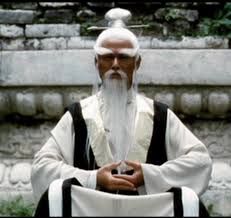
So I have been thinking about teachers lately. My own of course, and my role as a teacher. And that has led me to thinking about the images we hold of the martial arts teacher. When you think of a sensei, a sifu, a martial arts teacher, who comes to mind? Pai Mei? Master Po? Mister Miyagi? Or, as a kind of amalgamation of martial arts tropes, Yoda? While the image may vary, it is usually a frail looking old man who can demonstrate amazing skills and easily defeat any comers, including any of his students. It is a classic trope, really, perhaps as firmly rooted in the culture of the martial arts as anything. And like so many tropes, it is mostly BS, defying biology, logic, and at least my experience.
Fiction I am

Of course, it does have an element of truth to it, that’s how these things start. If you want knowledge, go to those who have it. People who have been training for decades learn things. They develop skills that neophytes simply cannot have. And maintaining your training can maintain phenomenal athletic abilities even as people age- I remember Matayoshi sensei teasing me in the early 90’s about being able to jump higher than I could in one technique. A well trained 68 year old can do things a 28 year old can’t, especially if the 68 year old gets to choose the points of comparison.

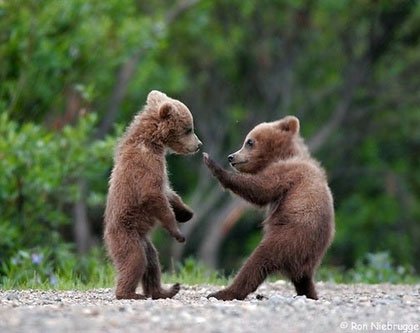
But that misses the point. Yoda simply does not exist. No one is undefeatable, at any age. Everyone is just human and as we get older our bodies change, we can’t stop that. And, given that reality, the trope of the incredibly skilled master easily able to handle any challenger creates an unreasonable and counter productive model for people teaching martial arts. It sets up an expectation that the teacher be near super-human, and worse, that he or she can never be surpassed. If it is an image that the teacher feels a need to live up to it can lead to some extremely dysfunctional things, including holding students back, teaching poorly, and creating mystic “powers” or “secret knowledge”. And the same goes for the students: if they need their teacher to live up to that super human image it can create real problems, including giving up one’s own autonomy, or denying the realities of practice.

One problem with legends and myths is that we know we can’t match them. It’s a dead end. If the master is undefeatable, and I know I can be defeated, then I can never be the master. No one can, and on some level I know that as well. That can feel pretty demoralizing. I love stories about the old masters and the superhuman things they could do. But really? Defeating tigers and fighting off dozens of armed men? It’s fun, not fact. And thinking of it as fact, believing it, both sets an impossible standard and prevents people from seeing the reality of their teachers, and of their own training. If the teacher is doing (or claiming) something you know is impossible then you know that the system is, somehow, rigged to create that result. You have a choice then: buy into the system, or leave it. And this doesn’t have to be levitation or no-touch knockouts, it can just be a guy who stands in front of a class and says he can’t be hit, and then sets up a whole set of rules that makes that the case.

When you are running a class, or a dojo, you have a lot of control over what material is covered and how it is approached. Insecurity, or image, or simply habit, can lead to teachers not allowing students to challenge them (“you don’t hit sensei!”), or to running classes that play to the teacher’s strengths. For example, I am better at controlling pressure weapon to weapon than most of my students, so if we spend a lot of time on training that emphasizes that I will usually come off as “better”. If you run classes try it. You can run a class in which you are always “winning” simply by setting the rules of the drills, doing drills that play to your strengths, changing things and keeping the class catching up, and setting rules for the dojo, like limiting contact or open oppositional training. In particular setting up a training structure that emphasizes drills with specific outcomes, and maintaining an atmosphere of authority, where the sensei/instructor is the only source of knowledge and cannot be questioned, play to an image of the teacher being unbeatable pretty well.

Students may do this too. Falling when they are “supposed” to, letting the teacher get in shots they wouldn’t let in from another student, accepting information or instruction that may be questionable. They may not even know they are doing it, particularly if the rules, as I said above, support the authority of the teacher over the experience of training. If they play to the image. And if they have been conditioned to do it, on purpose or not, well….

I think this drives people away from traditional martial arts. It is clear these teachers are not super human, even the great ones. And while some folks might want the story bad enough to push down the inner voice telling them something isn’t right, more will simply walk away. Stories are great, but needing to buy into a teacher that can do things that are impossible, needing to aid and abet that story as you invest more and more into it, needing to believe something that some part of you knows isn’t true, can be exhausting. And a complete waste of energy.

Of course the image of the teacher as the main arbiter of knowledge may be important for a number of reasons. On a practical level, your students need to trust you for you to teach them. If they don’t, they won’t listen and won’t learn and every class will be a constant struggle for authority. So on one level establishing and maintaining that authority is important. But that is where this trope can become rather insidious. It can push the teacher (or the students…) to go past that needed level of respect, one that incidentally should be earned not assigned, and instead work to develop and maintain a myth. It can help create environments where the teacher (or the structure of the group, or the other students) limit and control the student, keeping them down instead of helping them grow. All to make sure the teacher stays unsurpassed. But everyone gets surpassed eventually….

A good teacher should be able to maintain authority without always needing to be “the best”. Indeed, a good teacher should be pushing his or her students to excel, not keeping them in their shadow. The teacher should also be showing students where they think their own skills are lacking and how they are working on them, so they can be an honest role model. But that heroic image is often there in the background, for both teacher and student. Breaking away from it can feel like letting the side down, like you are not the martial artist you should be, and for your students like they don’t have the teacher they could. I know from experience, both as a student and as a teacher, that students like to have a teacher that exemplifies some of the tropes, these myths. It can be inspirational, and cool; part of the experience. But in the end, myths are not real and perpetuating some of them can be damaging. How then can we situate ourselves in this context?

First off, recognize it. No one is that good. Everyone can be beat. If it seems impossible it probably is. So if you want a teacher that is super-human, re-assess. You will never find one, though you can probably find one who claims he is. (The same goes for a teacher that is a perfect human being, or can bring perfect wisdom to your life outside your training, but that is a different story.) You can, however, find a good teacher, perhaps with exceptional skills, who can help guide you in your training. So stop looking for a hero or a guru and look for a good teacher instead.

This is one area where competitive arts have an advantage. They are used to this issue and have some simple and well tried solutions. First, if the teacher is a competitor the group can see how well they do, both in a public venue and in competitive training in the dojo. Everyone understands that different people can do different things, and that everyone gets beat sometimes. While one can certainly be a dangerous opponent well past middle age, there is a reason many sports have a “masters” class for competition, and you don’t see many 60 year olds out there fighting at the highest levels of open competition. Speed, endurance, and ability to recover from injury all decline as we age. Training can offset a lot of this, but not all, and that is normal. But what does that mean for a teacher?

Experience and training hold valuable knowledge and passing it on is essential to the transmission of the art. Someone with 20 or 30 or more years of training will have skills and knowledge his or her juniors will not. And you need those physical skills to transmit them. In a sporting environment there is a pretty clear understanding of the difference between specific skills and overall competitive ability. The main role of a teacher or coach is teaching, passing on those higher level skills, focusing on the students and the dojo, not on competing themselves. The coach doesn’t have to be able to beat all the competitors, he or she has to be able to coach them.
What the heck is wrong with you? Of course I can be beaten. Me being beaten is just a finger pointing at the moon.

And this returns us to the trope we started with. It implies that the best practitioner is by default the best teacher. That you should find the best fighter or master and learn from them. After all, they are undefeatable, right? Getting students by winning competitions or having a rep for being an amazing artist is a pretty common way of doing things. Just look at all the trophies, ranks, or awards you see in many dojo. They denote status as practitioners. But pay attention! They denote the teacher’s ability, their successes and status. But it might make sense to look at the students’ successes instead.

Teaching, training, and fighting are different skills. I’ve met a number of great martial artists who simply could not teach. They would have their students do the same drills they did, they would try their best, but they didn’t know how to help others learn. And while “waza wo nusumu” is essential to learning, without a good teacher it is pretty darn hard to progress, and near impossible to see your own failings and how to correct them. Sure, knowing how to succeed yourself might be helpful, but you don’t need to be the best overall practitioner to be a good teacher. To help a student progress you mainly need to know how to teach them.

Look at it this way: would Mike Tyson’s coach have beat him in the ring? Unlikely. But that coach was invaluable. I doubt any high level competitive athlete could run his or her own training program and be successful. Classical martial arts are no different. You need someone who can analyze what you are doing, understand what you need to change to improve, and develop a training program that gets those results. That is a completely different skillset to being a good fighter or martial artist yourself. That doesn’t mean there isn’t overlap, it just means that to be a good sensei, a teacher, you have to be able to teach, not just train. And you have to put in the time to learn those skills, as they don’t come from osmosis or through training. Or by being good at the art.

So instead of looking for a teacher that can defeat all comers, a silly quest anyway, one might be better off looking for a teacher whose students are consistently good at the art. If the teacher is focused on maintaining his or her status or image then they have incentives for not pushing their students to exceed them. They also have less incentive for learning how to really teach. If they see their role as a mentor as important however they may have taken the time and effort to learn how to teach, as well as taken the time to understand their own goals and their role and how that affects their practice and instruction. They may have taught themselves to understand and manage the tropes we are talking about, and their consequences. Don’t get me wrong. A martial arts teacher who is not still training and trying to learn and grow isn’t going to cut it, at least in my opinion. And a teacher better have some skills. But that image of the old, preternaturally skilled and undefeatable teacher isn’t doing anyone any favors. If you find a teacher who has been teaching for 20 or 30 years, again I’d suggest looking at his or her students. If none of them are as good or better than the teacher in any aspect of the art, if it were me I’d go elsewhere. They may be an amazing practitioner, and they may be doing their best, or they may be holding their students back, but either way they are not teaching well. And what are you there for? To sit in a room watching an amazing practitioner, or to get some guidance in how to become one?
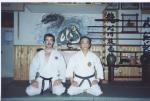
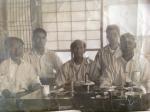
Sakai Ryugo and the Ryushinkaikan

One of the people that has had a profound influence on my practice is Sakai Ryugo. He is relatively unknown and so I thought it might be nice to share a little more about him and his Ryushinkaikan dojo.

Fred Lohse, Sakai Ryugo, 1992

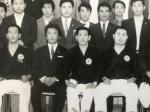
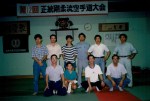
With Higa Seiko, Toguchi Seikichi, Yagi Meitoku, and Yushun Tamaki

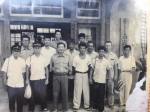
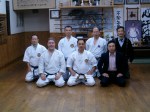
With fellow students, including Kanei Katsuyoshi, Toyama Zenshu, and Masanobu Shinjo

With Matayoshi Shinpo, Kanei Katsuyoshi, and Miyahira Shoshin

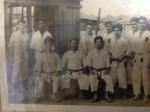
Sakai Ryugo was born in 1932 in Kagoshima prefecture. He moved to Okinawa with his family in 1949 and began studying Shorin ryu with Omine Chotoku in 1950. In 1952 he entered the Goju Ryu Karate Do Kenkyukai dojo. The head teacher and president was Higa Seiko sensei and he was assisted by a variety of people at that time, including Fukichi Seiko, Takamine Chokubo, and Toguchi Seikichi. (Miyagi sensei was still alive then, but I have no idea if Sakai ever trained with him. Neither does his son.) Though he maintained his training with Higa sensei, when the Shoreikan was founded by Toguchi sensei in 1954 he went with Toguchi and acted as an assistant instructor. Some of his juniors in the early years were people who later became famous in the Goju community and started their own organizations- Kanei Katsuyoshi, Shinjo Masanobu, and Toyama Zenshu, among others.   His wife said she thought he helped design the Hakutsuru no mai in the Shoreikan, and also thought that he and Toguchi at one point were going to work on a tiger kata but I don’t have any other information on this. During the years he was on Okinawa he also became friends with Matayosh Shinpo, studying kobudo and some empty hand with him.  They remained friends throughout his life and he considered Matayoshi a strong influence on his training. (In the demo photo for the 25th passing of Matayoshi Shinko he is seated next to Kina Seiko and in the demo photo for the 1999 memorial for Matayoshi Shinpo he is seated at the front, next to Kinjo Kenichi. (Photos annotated by Viet Ha Quoc.) He remained in Okinawa training and teaching until 1962.

Shoreikan, 1958

In 1958 he began traveling periodically to Amami Oshima and started what may have been the first karate and kobudo dojo there, a Shoreikan dojo in Naze city. He started teaching full time at Oshima High School and in the Amami Shoreikan dojo in 1962. For the next 5 years he taught all over Amami and and laid the foundations for the Amami and Naze City Karate Associations.

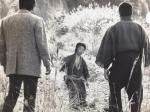
Still shot from the set.

In 1967 he moved to Kagoshima city and began teaching in what is now Kagoshima International University. While he maintained the dojo in Amami his main dojo was in Kagoshima from this point on. He opened up the first Ryushikaikan dojo in 1969 and founded the Kagoshima prefectural karate association in 1970. In 1971 he formally founded the Amami and Naze karate associations and one of his students opened his first Shibu dojo, in Miyazaki. In 1972 he demonstrated at the ceremony in Kagoshima to celebrate Okinawa’s return to Japan, with Matayoshi Shinpo. His dojo was a founding member of the Zen Okinawa Kobudo Renmei and remained part until the passing of Matayoshi Shinpo. He founded shibu in Fukuoka, Kansai, Kyoto, Tokyo and around Kyushu over the next 15 years, did demonstrations on NHK, TBS and Nippon Television and had a small role in a Tohei films movie with Sonny Chiba, The Power of Aikido (Gekitotsu Aikido激突 合気道) as a kama wielding fighter. Starting in 1980 he began having an annual Goju Ryu gathering in Kagoshima city. The honbu dojo moved to Shiroyama in 1981 and to the first floor of the house he built in Tagami Dai in 1984, where I trained and where it remains today. Sakai Ryugo sensei passed away in 2002, leaving a legacy of excellent students and a reputation as a gentleman and a dedicated karate and kobudo practitioner.


With Toguchi, Anthony Mirakian at far right, late 1950s.

I met Sakai sensei essentially by pure luck. A couple of weeks after I moved to Amami Oshima in 1990 I went to Okinawa for the first time. While there I asked Nakasone san at Shureido for some advice on a dojo near me. He suggested I get in touch with Sakai sensei, in Kagoshima city. The first time I visited the dojo I went with a fellow English teacher, Ann Denion, who was training there. I had a great time and returned to train every time I visited the city, roughly monthly, sometimes more. As an amusing aside, during that first visit I noticed a photo on the wall of a young Anthony Mirakian at a demo in the 50s, from when they had trained together in the Shoreikan. I had trained with Mirakian sensei 2 months earlier, visiting his dojo with Kimo sensei before leaving for Japan, and even more recently, completely coincidentally, we had had lunch together in Okinawa on the same trip I got Sakai sensei’s contact information. Sakai was pretty surprised, and so was Mirakian when he found out! Goju is a small world… I  didn’t succeed in getting them in touch until a number of years later but after I got back to Massachusetts Mirakian sensei shared some photos and some wonderful stories with me, including one about Sakai having to forcibly evict two rather impolite marines from the dojo one evening. He had a great deal of respect for Sakai sensei and I was happy I could put them in contact after more than 30 years.

After the visit, on Amami I got in touch with a two former students of Sakai sensei’s. I trained in Nishi sensei’s Shindokan and Toguda sensei ran a small Shoreikan dojo primarily for kids and gave me a key so I could practice on my own when I wanted. The following year I moved to Kagoshima city and trained in the Ryushinkan full time. Sensei also gave me a dojo key and I wound up there some off nights, when I was not doing Ufuchiku kobudo with Masada Kei’ichi or Jigen Ryu. Training was fantastic. Sensei ran most of the classes and was both a great teacher, as evidenced by the caliber of his students, and a fantastic technician. My other main teachers were his son Sakai Ryuichiro and, most importantly, Nagata Ryudo, who treated me with great patience and worked with me hour after hour. The seniors were in incredible shape, and had a balance of hard and soft and an ability to move that I was astounded by.

Sakai Ryuichiro, Fred Lohse, Sakai Ryugo, Nagata Ryudo, 1992

When I returned home I stayed in touch but after a stay in 1995 while doing research for my masters’ I was unable to visit for about 10 years. Unfortunately before I could get back Sakai sensei passed away. His son and another senior student, Miyagi Tatsuhiko, took over the dojo. I have brought a couple of students to visit over the years and they have enjoyed training and have also remarked that they could see where some of my technique comes from, which I take as a real compliment.

Sakai family, 1991

Miyagi sensei is the main teacher there now. He has also been the first person to create any on line presence for the dojo, primarily through his Facebook postings. He is a fantastic technician, and I can’t think of many people 30 years younger (he is in his mid 60s now) stronger, more flexible, or in better overall condition. But the lack of public notice of the dojo is, in some ways, a real shame. Training there has had a profound impact on me. Not only did I learn a great deal about our karate and kobudo, but I learned even more about how to build and keep alive an adult dojo, keeping up high standards and doing so in a way that was very demanding but also very respectful, with a place for blood and sweat but also for humor.

I could tell a number of stories of course- Sakai sensei chiding the class for not listening when he had me teach Sepai, because since he had asked me to were they thinking he didn’t know who could teach?; Sakai sensei lecturing us in seiza for 45 minutes and the whole class’ legs falling asleep and none of us being able to get up and do soji afterwards;  him (much to everyone’s surprise) giving me a hug after my sayonara party; hours and gallons of sweat; getting knocked and choked out; sharing watermelon on the dojo floor; his making sure I was as comfortable as possible sleeping in the dojo during my visit in 95. So many more, vignettes mostly but they stick in my mind. But those are really about me, not him, so I will stop there.

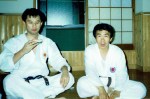
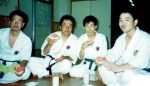
Eating watermelon

after training.

As for what was taught in the dojo, it was the classical Goju Ryu kata, of course, and some of the fukyu kata (geki sai san, geki ha, etc.) that Toguchi sensei had created, though done in a looser fashion. I did many of the same subjects under Kimo sensei and when I asked Sakai about the 2 man bunkai and kiso kumite, he told me that while he had done them for many years he felt they did not represent Goju Ryu well for a variety of technical reasons. Instead he used the kata as training tools and focused pair work on applications of the classical kata, kakie, and some drills he had developed- including seated, ground, and weapon-countering techniques- from what he had been taught by Higa and Toguchi. He taught Matayoshi kobudo as well, and was particularly good with the kama. His small weapon kata were a little different but when I asked about that he told me “Sensei was working on many things in the old days and I wanted to keep certain techniques that I liked so I adapted the kata, kind of like sensei did.”

The seniors were all in incredible shape but interestingly enough we rarely did any type of calisthenics in class. We would occasionally do a few but most of the work with the hojo undo and daruma-taiso esque exercises the seniors did, as well as makiwara and bag work, was done before or after training, or at home. “Up to you to be ready to do karate” sensei told me. Luckily I was working with the chishi before class at the time, not coming in late and out of breath….

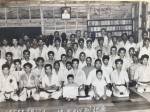
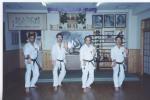
Goju gathering 1992

Class was always demanding. Lots of kata, body conditioning, kakie, solo and two person basics, stepping, and application of kata. The standard was very high, but the atmosphere in the dojo friendly. I remember going to get water from the hose I had seen outside the dojo door on my first visit. One of the students went to stop me, and Sakai sensei yelled from across the room for him to let me go. Water was usually not allowed until training was finished but there was a huge puddle around where I had been, mostly because I was not used to the Kagoshima summer heat, and sensei told Shinji “if you have a puddle like that you can drink too!”.  The rules were for reasons, not just because that was how it was always done, and that went for mechanics and application as well.

After training 2008.

That included the rules for both doing and applying kata. Principles are a buzz word today, but they were certainly present in our practice then. In addition to some colorful traditions around the four animals of Goju- the crane, tiger, snake, and hawk, Sakai had some very clear ideas about how to apply kata, including what angles to use and why, when it was appropriate to strike vs. grab, when to use one or two hands, off balancing and kyusho as a part of any application, what is useful at different ranges, how to control range, turning and slipping as shown in the kata, and adapting to the situation, among other things.  I remember a great moment doing applications from Suparinpe when one of the seniors was too close for the jumping kick and so backed off; sensei “asked” why he didn’t just knee: “application is based on the opponent, you should be able to do whatever needs to happen, jumping knee, flying side kick, whatever the situation requires”. His dojo is the first place I heard the term “fajing”, Japanized as “pachin” (his short power was excellent) and we had clear, non-elusive, discussions of kyusho. Most importantly he structured our application training to demonstrate and include all this information. It was great fun, and very demanding training.

But technique is only part of what he taught. The most important thing I took from his teaching, and the dojo he developed, was a strong sense of respect. Yes respect for the art and our lineage, but mostly for people. It started internally- you had to work to grow and when you were pushing yourself both you and everyone else knew it. But he also demanded that everyone in the dojo treat each other with respect. He insisted on students treating each other as just karate ka, not men and women, Japanese and gaijin, doctors or delivery people, or whatever else they were outside the dojo. Roles outside the dojo were just not important inside it. (Though the purpose of this discipline was not a kind of post-modern social enlightenment; the rigor of training was supposed to help you have the proper fortitude to fulfil your given role in the larger society. To be a good citizen.) He made sure everyone was working hard and that no one was treated poorly. Go and Ju, as it were.

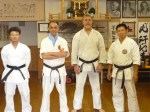
After training, with Sakai Ryuichiro, and Miyagi Tatsuhiko, 2014

There was a lot of sweat in the dojo, but a lot of laughter too. I could see how close many of the people had become and I still wish I had had more years to train there. I consider myself lucky for the experience and every time I go back I am happy to feel welcome, and to train together again. When I visited for the first time in 10 years I remember seeing my name still on the nafudake and how that affected me, but that was how the dojo was run. Once part of the group you were treated like family, both welcome and having certain expectations to live up to.

It is too bad, though not surprising, the group has gotten so little notice. Sakai sensei was a little slice of an earlier time training in Okinawa, before the organizations and fragmentation of today. The karate taught there is definitely not a sport. It is also some of the best karate I have seen, in or out of Okinawa. Training there has had a profound effect on how I train and teach to this day and I would welcome others having that chance. (There have been a few foreigners through the dojo over the years- Ann, whom I mentioned, Julia Henker, Glenn Forbes, and Michael Hazel have all trained for extended periods of time and besides a couple of my students my friend Mario McKenna and some of his students have visited a number of times.) That said, there is no easy path. Kagoshima is not Tokyo or Okinawa, and there is no one in the dojo who speaks English (or any other foreign language). No one is going to get quick rank or even quick access to information. Most all of training time is spent on what might be

After training with Miyagi Tatsuhiko and Tania Tzelnic, 2012

considered “basic” training. The first 4-5 months I was in the dojo the only kaishu kata I got instruction on was saifa, even though I knew the rest of the system. Until my mechanics in saifa were up to snuff I could follow along but got no feedback on anything else. Once there things opened up, but the standards were the standards, and anyone who wants to train should be prepared for “a little light training”, as Miyagi sensei has a tendency to say before a 3 hour pre-training run through hoju undo, stretching, makiwara, and basics. Only one way to get good, I guess.

In any case, famous or not, I miss Sakai sensei. He was an amazing teacher and martial artist, and was a real gentleman. I can’t think of anything better to say, so I will end with that.

At the Sakai family tomb, 2017

Thank you to Sakai Ryuichiro, Miyagi Tatsuhiko, and the late Anthony Mirakian for information and photos, and of course many thanks to the late Sakai Ryugo.

Drills, Exercises, and Understanding

A few weeks ago I was shown some “lock flows”. They were simple sequences of joint locks; in most cases each lock worked in the direction of the resistance to the previous one, a pretty common way to string them together. But in this instance the person showing them to me was slamming through the locks at high speed, with a fair bit of power and no attention to what their partner was doing. I realized they probably did not understand the drill very well, as that way it did nothing to train sensitivity to the opponent’s body- feeling for resistance, for when to apply and release pressure, for when the joint was open or closed, and for the rest of the body’s support (or lack thereof) of the joint. Done that way it was just a series of unconnected locks.

This is not unusual. Drills are just that, drills. They are not combat. But many people feel that their drills should be as “realistic” as possible. What that winds up meaning in practice is that they are done fast and hard, and are sometimes painful. While that may be something like combat it is not always good training. It is also really poor pedagogy, the old “when all you have is hammer” problem.

Training is a teaching and learning experience. You have a goal, a skill you want to develop, and you develop a curriculum to teach that skill set. Exercises inside that curriculum are designed to teach specific sub sets of the skills desired. To learn the skills properly, and as efficiently as possible, the drills need to be performed with a clear understanding of what they are teaching, how doing them inculcates that knowledge, and how you are measuring that.

So back to the lock flow. If the goal is just to memorize locks (a highly questionable goal to begin with) there are better ways to do that. If the goal is to learn how to move between joint attacks based on the resistance that your opponent is giving you, with an understanding of how your structure, his or her structure, and your relative strengths and positions will affect the outcome, you need to practice with that clearly in mind. You need to give your partner a chance to apply resistance, you to feel that resistance and react, you both to adjust your reactions based on the other person’s actions, and you need be able to do it relatively safely. If you slam through them with no attention to your partner there is no conversation, no flow. Your partner is also likely to go with your attacks easily to minimize their chance of getting injured, which further prevents you from feeling the resistance and exchange you are supposedly training.

This does not mean this drill needs to be performed weakly or at a snail’s pace, just that you both need to understand what you are trying to do and why, and communicate about it- what is the process, how are we measuring success, how much power and speed will we use, and how is that going to affect the goals for the drill. If you can’t do that and adjust accordingly, you may not actually know what you are trying to do, or how to do it, which means you won’t learn what the drill is supposed to teach. Even worse, you may associate skill with the way you are doing the drill- “It is hard, fast, and it makes my partner tap quickly”- with ability in the skill being taught “so therefore I can do joint locks on a resistant opponent”, which is probably not the case. Instead of learning a skill you will have learned a drill, and in the process possibly created a false sense of ability, a terrible thing indeed.

Is his head the hammer or the nail?

Is his head the hammer or the nail?

This process is the same for every drill you do. None alone can replicate combat. If they did you would have broken and dead training partners. Every single drill you do, every training exercise including full contact fighting, is a shared fiction. It is a story that allows you to replicate a piece of what happens in combat so you can learn how to deal with it. The rules around them are set up to allow you to learn. If you understand them and their purpose you can understand how they focus the drill on the skill being developed instead of it being just physical exercise with a martial flavor. You can also understand what the drill does not do; in that way you don’t think you are training something you are not.

For example, in one of our paired drills both people are free to attack or defend in any way, to any part of the body, including eyes and groin. The only rule is both people have to keep it slow and controlled. It is designed to give you time to feel how both peoples’ movement affects power and position, how your position affects options, and how to take advantage of those options. It has to be done slowly to do this. Speed it up too much and you don’t have time to recognize new options you can later put into other higher speed drills. Speed it up and you have to stay away from the eyes, throat, groin, etc. as a quick mistake can have serious consequences. Speeding it up too much means you can’t start to feel those new options on a physical level. But people have a constant tendency to speed up- it feels more “real”. They especially do this on defense, breaking down the story in a one-sided way, creating a totally false sense of success. So we have to remind ourselves of the reasons for the rules, and keep going back to those reasons in practice.

Like most drills it is only one part of a larger training protocol, one designed to work as a whole to develop skills. Taken on its own it has a variety of flaws. I have never seen a drill that does not have “flaws” if looked at from the perspective of something it is not designed to teach. For instance this drill does not teach hand speed or dealing with an adrenal rush very well, and those things are important. But it is not supposed to, we have other drills for that.

There are many ways to train. If you want to be totally realistic come into the dojo and fight until only one person can walk out. To the hospital, probably. More realistically, hide behind the door to the dojo and hit everyone that comes in with a bat. Even then they are coming to a place where they know physical violence is the subject, so better to surprise attack them somewhere else. I don’t think that is a very good pedagogical method though.

Instead, understand your drills, what they are teaching, and how the way they are performed affects what you learn from them. The things I see that make the biggest difference, and are most often done poorly, are range- a little too far away and any successful defense is an illusion, speed- fast feels good but speed can hide a host of mistakes and eliminate a whole set of learning possibilities, and contact- sometimes hitting hard is essential, sometimes it does not help.

Kamae!

Kamae!

Your drills are your stories. Understand those stories. They have a narrative; if the narrative is broken you may come up with a better story. However, you are more likely to wind up with the three bears eating Goldilocks and then going to sleep congratulating themselves on defending their home from a serious threat and believing they don’t have to be afraid of humans because they have learned how to deal with them. A real fable.

Schedule Changes

As of January 1st, 2015, there will be two changes to our training schedule.

1) Weeknight karate and kobudo will now go from 7-9 PM.

2) Starting in January our Feeding Crane training will shift to every Tuesday night. It is a welcome change! Feeding Crane classes will be taught alternately by Fred sifu and Mike Larimore sifu, and of course we will be training together with Mirakian sensei’s students in Watertown. 411-Sakai sensei dojo-bunkai 10

These should be some good changes for 2015. Looking forward to another great year of training here at Kodokan Boston!

So Far Away From Me….

Take a look at this video, posted by a close friend of mine:

http://http://vimeo.com/104945404

It is in general excellent Okinawan martial arts. Powerful. Precise. Fast. Displaying the mechanics and tactical choices of the system. I like it. But I do have one small problem with it, the distance between the participants. On the first attack of each set the attacker has to take a full step in. Then, if you watch closely, you will see that many of the attacks at their full extension fall short. (The counters are then set at proper range- they can penetrate.) This is an excellent range for demonstrating, which is what is happening here. It is a good range for seeing what is coming, and for working prescribed counters. It is a good, or at least common, starting range for various types of sport fighting, for dueling. It is a good range for practicing entering and for maintaining distance. It is not, in my opinion a good range for practicing self defense.

Why? At this range I have a better solution for dealing with the incoming attacks: run away. There is time and space for it. Yes, I am aware you can create a scenario where that is not possible. But at this range there are a lot of movement options open. For self defense, these should be the first options. To me, this looks like mutually agreed-upon combat. A duel or a fight. In other words, unnecessary.

Physical self defense is a last resort. You didn’t see the set-up, you were not able to evade the situation, you were not able to escape the attacker. You were forced to fight. If you are both agreeing to fight it is not self defense, it is just fighting. This, I believe, runs contrary to the principals of Okinawan karate. Our art is a civilian self defense system, geared towards dealing with close range personal assault. To practice for close-range defense I believe most drills like this should start inside striking range, and stay there. By this I mean two things: start attacks close enough to hit and make sure attacks can penetrate.

How can you make sure you are doing this? When doing paired work of any type, before starting have the attacker just reach out and place a palm on the defender’s chest to test range. If they have to move their feet, turn, or lean in to touch, they are too far away. Starting this close runs contrary to a lot of martial arts training. It certainly is very different from any type of sport sparring or fighting. But it does a number of important things:

First, it gets you close. If you do not train this close, at first it may feel uncomfortable. This is good. It is actually teaching you something. It is teaching you what someone’s effective striking range feels like, and teaching you to feel comfortable being at that distance with another person.

Second, you have to pay attention differently. You can’t rely on direct vision, you have to use your peripheral vision and your sense of touch. You have to pay attention to your opponent’s entire body. Since any attack can land right from the start you can’t relax mentally. If you are going hard you also have to deal with the nervousness or fear that comes with potentially being hit right from the get-go.

Third, you have to move differently. You can’t do wide blocks or big movements fast enough. Speed in defense will come in large part from technique and position. You can’t effectively retreat in a straight line, you have to angle or enter to defuse attacks. You also quickly realize you have to prevent follow-up attacks with your first defense.

Fourth, your techniques will actually be different. You may start to see where elements of the system that seem more stylistic come into play. Things like controlling the center line, keeping your elbows in, how you use your hands in tandem, not bouncing when you move, shifting quickly to angles, all make more sense at this range.

At the same time, applying counters is very different when attacks can penetrate. You wind up with more energy to work with and in essence more options. For example, it is pretty hard to do an effective throw or joint lock when your attacker is at arm’s length, unless they just let you do it. (You might also find that certain techniques will not work…)

Finally, you should stay in range throughout. Otherwise the attacks and blocks are really more of a dance. Practicing with attacks and defenses making contact outside hitting range is a common occurrence, especially in weapon work. But if your attacks can’t reach they are not attacks, no matter how fast and powerful they are just waving a weapon, or your arms and legs, around. And your defense, no matter how quick and clean is only a defense if it is protecting you from something that might get in. With weapons, if you are not trying to hit the weapon to disarm or create an opening the target is the person. With empty hands it is always the person. If attacks cannot reach the target, there is no need to block or otherwise pay any attention to them. They are not really attacks.

This does not mean hit with every attack you can. You don’t want to be smacking sticks into each others’ heads. It means to practice so attacks are in range and able to hit, and then decide when and how hard to actually make contact. That way you are doing martial arts, not dancing.

So try practicing at close range. Practicing to defend against attacks that come from out of range and cannot hit is actually less productive than not practicing at all. It gives the illusion of martial practice without any of the intent.

Feeding Crane Seminar, June 2014

Sifu Liu Chang’I will be in Boston twice this year. The first time will be in June. We’ll be having a seminar on his family’s Feeding Crane Gong’fu June 21st and 22nd, Saturday and Sunday. It will, as always, be a great time! There is more information on the Events page of our site, and the sign up and information sheet is here. Please contact us if you would like any more information. We are looking forward to a fun weekend and hope to see you there!

_LE20527

Too Many Black Belts?

So I had a conversation a little while ago about rank. Someone was saying to me that they felt a certain dojo had too many black belts. The implication was that standards were low. I am not going to speak to standards here: the last thing the anyone needs is yet another rant about McDojos and what they are doing to the martial arts. However, the idea of a dojo having too many black belts stuck with me. If you have been training for a while you have probably noticed that not that many people stick it out. For arts that use that ranking system, just before or just after black belt is one time where you see a lot of attrition. So given the turnover, and that it often happens right around black belt, it seems obvious that a dojo with a lot of black belts is giving them out too easily. Otherwise they would be rare, since people that stick it out are rare.

But that is bad math. Bad statistics, really. How many people stick it out in general does not matter. You are not looking at the entire population of people who have ever trained, but at who is currently training in a given dojo. If a dojo is a good one, and by this I mean one where there is a solid knowledge base, good teaching methods, high standards, and a collaborative atmosphere, there should be a high percentage of black belts. If the knowledge base and atmosphere are good people will stay. Not all. Maybe not even many. But some will stay. And unless the teaching is bad they will learn. And since 1st degree black belt is a relatively junior rank, they should eventually become black belts.

People that stay learn, and are (eventually) black belts. People that leave leave, and are therefore not counted when looking at who is currently training. So at any given time only the newer members will not be black belts. The statistics are simple: in a well established dojo with high standards you should see a large proportion of black belts. If not, it means either no one is staying, or no one is learning. And that would not be a good dojo.


Master on the Mountain

Pai Mei

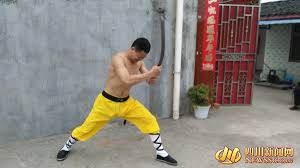
Everyone knows this image: the old master of the martial arts living alone on a remote mountain top, students coming to him for wisdom and training. His mastery comes from arduous training and an enlightenment that springs in part from his solitude. It is an image that plays perfectly into our “self made man” ideal, and I see it reflected in martial artists who claim they “just train alone”. A nice image, but in my opinion it is nonsense.

This stereotype does spring from something. Training is a profoundly lonely task at times. Endless repetitions, hours spent developing strength, stamina, and mechanics, and knowing that while your teacher can guide you, you are responsible for your progress. No one else but you. That is lonely. Nevertheless, for most of us, and certainly for any real martial training, our practice is actually a profoundly social act.

Day after day, year after year, we come down to the dojo and train. Sure we also train alone, but we train with others. We are members of a dojo, or a club, or simply a group of people who share a common interest. We come together to learn, to sweat. We share our weaknesses, our failures, and our successes. We rely on each other for support, assistance, criticism. A group that is really pushing you will see you fail. They will see parts of yourself you like to keep hidden- fear, lack of faith in yourself, laziness. They will also see you succeed and develop. You have to trust them with your safety, and with your emotions. You have to be trustworthy the same way. I don’t know about you, but to me that is pretty personal.

And it cannot happen alone. To push your boundaries in the martial arts you need people to work with. In primarily solo activities- strength training, forms, flexibility, etc.- partners help you push past barriers, show you where you are making mistakes. But while you may be able to develop strength, form, or flexibility alone, you will never learn how to apply them without partners.

Real martial arts are interactive because violence is a form of social interaction. In learning to deal with it you need to feel other bodies, deal with different weights, sizes, ways of moving and ways of thinking. You need to respond to attacks and learn how to manipulate an opponent, physically and psychologically. An imaginary attack is just that- it has no intent, no feeling, no heft. Without partners, the arts are a hollow shell, like learning a foreign language without ever speaking to anyone: how do you know if you can communicate? So training is, has to be, social.

And that is a good thing. While the ideal seems cool- being a master sitting on a mountain alone- who really wants it? I don’t. I would prefer a group of friends around me. We share sweat, pain, failure, and sometimes blood. We share laughter, achievement, and the pure joy of training. And more. We have dojo parties, go out for an occasional drink, know each others’ families, share milestones like weddings and birthdays. If I am going to spend this much time at something, I want that something to have depth, value. If I am going to show that much of myself to a group of people, I want them to be people I trust and respect. People I like. They are my community, my martial brothers and sisters.

So when I hear about great masters or experts in the arts, I tend to wonder: who are their training partners? Who helped them get that good? Who do they continue to train with? Who questions and critiques them? Who are their friends? For me, who their friends are will show me more about them than their technique. If they have no friends, no training partners, and are sitting alone on a mountain, then I know all I need to.